
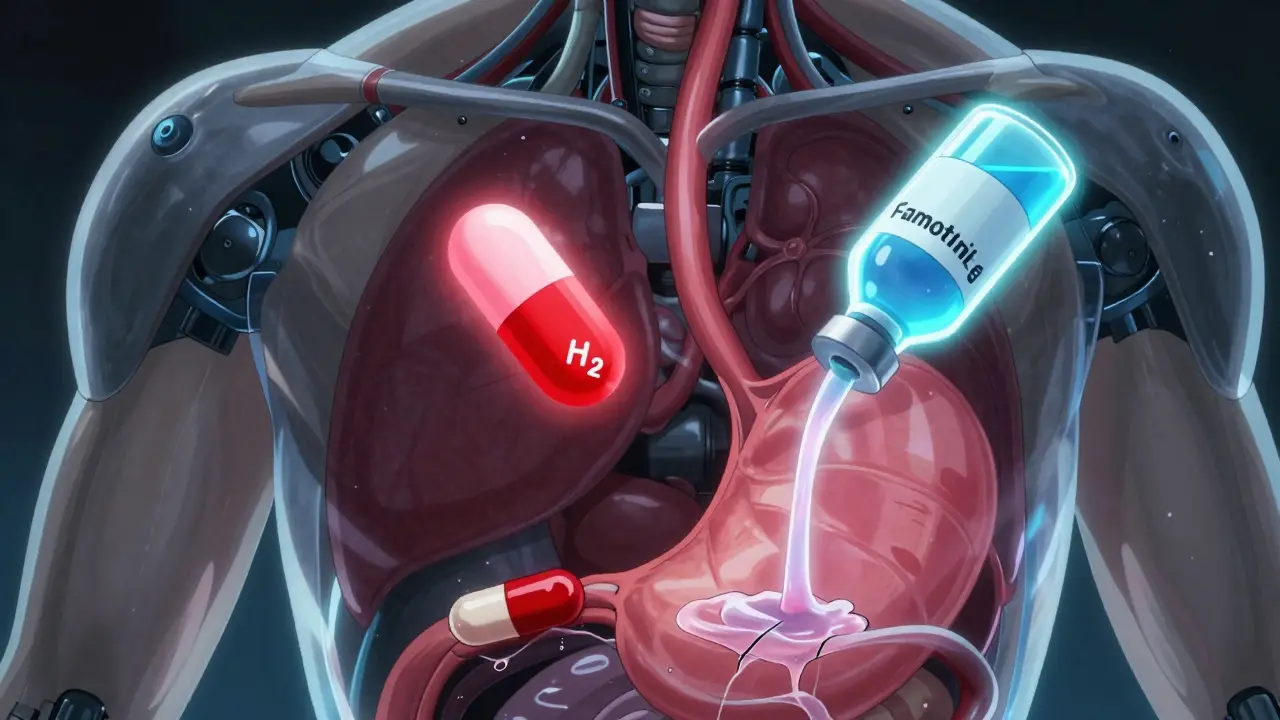
When you take an H2 blocker like famotidine or cimetidine for heartburn, you might not think about how it affects other medications you’re on - especially antivirals and antifungals. But these interactions aren’t just theoretical. They can mean the difference between a successful treatment and a dangerous failure. For example, if you’re taking itraconazole for a fungal infection and also use an H2 blocker, your body might absorb less than half the drug you need. That’s not a small risk - it’s a real threat to your health.
How H2 Blockers Work - and Why It Matters
H2 blockers, or histamine H2-receptor antagonists, reduce stomach acid by blocking histamine from stimulating acid-producing cells. This helps with GERD, ulcers, and indigestion. The three main ones still available in the U.S. are famotidine (a common over-the-counter and prescription medication for acid reflux), cimetidine (the first H2 blocker approved in 1976, now rarely used due to interaction risks), and nizatidine (a less commonly prescribed alternative). Ranitidine was pulled in 2020 after being contaminated with NDMA, a probable carcinogen.
The big issue isn’t just that they lower acid - it’s how much and for how long. Normal stomach pH is between 1 and 3. H2 blockers raise it to 4-6. That sounds mild, but for some drugs, that small change is enough to stop them from being absorbed.
Why Antifungals Are Especially Vulnerable
Not all antifungals react the same way. The azole class - including itraconazole, voriconazole, posaconazole, and isavuconazole - depends heavily on stomach acid to dissolve and get into your bloodstream. Itraconazole is the most affected. Studies show its absorption drops by 40-60% when taken with an H2 blocker. That’s not a typo. You could be taking the full dose, but your body gets less than half.
Fluconazole, though, is different. It’s highly water-soluble and doesn’t need acid to dissolve. So if you’re on fluconazole, H2 blockers won’t hurt its effectiveness. That’s a key point: not all antifungals are created equal.
Here’s where it gets more complicated. Azoles don’t just get affected - they can also affect H2 blockers. Cimetidine, for example, blocks liver enzymes (CYP2C19 and CYP3A4) that break down voriconazole. That means voriconazole builds up in your blood, raising the risk of side effects like liver damage or vision problems. The opposite can happen too: voriconazole can slow down how fast cimetidine is cleared, making its side effects worse.
Antivirals in the Crosshairs
Antivirals aren’t off the hook either. Atazanavir, a drug used for HIV, needs acid to dissolve properly. When taken with famotidine, studies show its absorption drops by up to 77%. That’s enough to let the virus rebound. The FDA specifically warns that you should take atazanavir at least two hours before any H2 blocker - not after, not at the same time.
Dasatinib, used for some cancers and sometimes classified as an antiviral in certain contexts, shows the same pattern. It’s poorly soluble without acid. If your stomach pH is too high, it won’t work.
According to a 2022 FDA review of 42 antiviral drugs, nearly 7 out of 10 had warnings about acid-reducing agents. H2 blockers were responsible for 28% of those cases - not the majority, but enough to be dangerous if ignored.

Cimetidine vs. Famotidine: The Real Difference
Not all H2 blockers are the same. Cimetidine has an imidazole ring in its chemical structure. That ring doesn’t just help it block acid - it also blocks liver enzymes. That’s why cimetidine interacts with over 40 other drugs, including many antivirals and antifungals. It can make your blood levels of voriconazole, theophylline, or warfarin spike dangerously.
Famotidine? It doesn’t have that ring. It barely touches liver enzymes. That’s why it’s now the go-to H2 blocker when you need acid control and are also on antifungals or antivirals. A 2023 IQVIA analysis found that 92% of patients switching away from cimetidine went to famotidine.
Even then, famotidine still raises stomach pH. So while it’s safer, it’s not risk-free. You still need to time things right.
How to Avoid Treatment Failure
Here’s what works in real-world practice:
- For itraconazole: Use the oral solution, not the capsule. The solution contains citric acid and absorbs better even with reduced stomach acid. If you must use capsules, avoid H2 blockers entirely - or space them at least 2 hours apart.
- For voriconazole: Monitor blood levels. The target range is 2-5 mcg/mL. If you’re on an H2 blocker, check your levels after two weeks. Dose adjustments are often needed.
- For atazanavir: Take it at least two hours before your H2 blocker. Never take them together.
- For isavuconazole: This one’s easier. It has fewer enzyme interactions and is less affected by pH. It’s becoming a preferred option in hospitals.
- For fluconazole: No special timing needed. You can take it with or without an H2 blocker.
And don’t forget: H2 blockers wear off faster than proton pump inhibitors (PPIs). While PPIs suppress acid for 24+ hours, H2 blockers last only 6-12 hours. That means you can time your antifungal or antiviral to be taken when acid levels are naturally higher - like right before breakfast or dinner.

What Clinicians Are Missing
A 2022 survey of 1,200 hospital pharmacists found only 43% consistently gave patients clear timing instructions for itraconazole and H2 blockers. That’s alarming. A 2023 study in the Journal of Antimicrobial Chemotherapy estimated that 78% of treatment failures from these interactions could be prevented with simple education.
The FDA flagged 17 cases of antifungal treatment failure directly linked to improper use with acid-reducing agents in 2022. Many of these could’ve been avoided with a checklist: “What are you taking for heartburn?” - asked during every medication review.
The Future: Better Drugs, Clearer Labels
The FDA is pushing for new labeling rules that will require all pH-dependent drugs - including antivirals and antifungals - to have clear, bold instructions about timing with acid reducers. That change, expected in late 2026, could cut interaction-related failures by 35%.
Meanwhile, new formulations are in trials. One lipid-based version of itraconazole (NCT04821542) absorbs well even at pH 6. If approved, it could eliminate the timing problem entirely.
Can I take famotidine with fluconazole?
Yes. Fluconazole doesn’t need stomach acid to be absorbed, and it doesn’t interact significantly with famotidine. You can take them together without timing restrictions.
Is cimetidine safe to use with antifungals?
No. Cimetidine strongly inhibits liver enzymes that break down many antifungals like voriconazole and posaconazole. This can cause toxic drug buildup. Avoid cimetidine entirely if you’re on azole antifungals.
Why does itraconazole fail when taken with H2 blockers?
Itraconazole tablets need a low pH (below 3) to dissolve. H2 blockers raise stomach pH to 4-6, preventing dissolution. Without dissolution, the drug can’t be absorbed. The oral solution bypasses this because it’s already dissolved in acid.
Should I switch from a PPI to an H2 blocker for my acid reflux if I’m on antivirals?
Possibly. PPIs suppress acid for 24+ hours, making interactions more likely. H2 blockers last only 6-12 hours, so you can time your antiviral to be taken before the H2 blocker kicks in. But even then, follow timing rules - don’t assume switching is automatically safer.
What should I do if I’m on both an H2 blocker and an antiviral?
Check the specific antiviral’s label. For atazanavir, take it 2 hours before the H2 blocker. For others, like dasatinib or ritonavir, consult your pharmacist or doctor. Never assume they’re safe together - many interactions aren’t obvious.
Next Steps for Patients and Providers
If you’re on an antiviral or antifungal, ask your pharmacist: "Is my acid reducer safe with this drug?" If you’re a provider, make a habit of checking drug interaction databases - the University of Liverpool’s HEP database lists 142 documented interactions between H2 blockers and antifungals/antivirals as of 2023.
Don’t wait for symptoms to appear. Treatment failure often shows up as a persistent infection, rising viral load, or unexpected side effects. The fix is simple: timing, choice of drug, and communication. But only if you know to look for it.




12 Comments
Siri Elena
Oh wow, another post that treats patients like dumb robots who can’t read a label. Let me guess - you’re the kind of person who thinks ‘take with food’ means ‘chase it with a burrito’?
Newsflash: if you’re on itraconazole and popping famotidine like candy, you’re not ‘managing your acid’ - you’re just playing Russian roulette with your liver. And yes, I’m talking to you, the person who ‘forgot’ to space them out because ‘it’s just one time.’
Also, cimetidine is basically the pharmaceutical equivalent of a back-alley mechanic who says ‘I fixed it’ while the engine’s on fire. Stop using it. Just stop.
Jane Ryan Ryder
This is why America’s healthcare is a dumpster fire
Callum Duffy
The precision of this analysis is commendable. The distinction between pH-dependent absorption and enzymatic inhibition is not merely pharmacological - it is foundational to therapeutic efficacy. One cannot overstate the importance of temporal separation between H2 antagonists and azole antifungals. The clinical literature, particularly the 2023 IQVIA data, reinforces what has long been known in academic circles: familiarity with drug interactions is not optional - it is a professional imperative.
That said, I remain concerned that such nuanced guidance is rarely integrated into primary care workflows. Perhaps the solution lies not in patient education alone, but in system-level integration of clinical decision support tools at the point of prescribing.
Chris Beckman
ok so like famotidine is fine but cimetidine is bad? i thought they were all the same??
also i take famotidine for my heartburn and i have to take this antifungal thing for my toe fungus and i just take them together cause why not??
also why does it matter if the drug dissolves? i mean i swallow it right?
also is it like 2 hours before or after? i always forget which one
Richard Elric5111
The reduction of gastric acidity is not a mere physiological adjustment - it is a metaphysical alteration of the body’s internal environment. The pharmaceutical industry, in its pursuit of convenience, has commodified the sacred act of digestion. We have replaced the natural order - the churning, acidic crucible of the stomach - with the sterile, algorithmic logic of pharmacokinetic tables.
When one takes an H2 blocker, one does not merely reduce acid - one severs the symbolic covenant between the body and the medicine. The azole antifungals, like pilgrims in a barren land, are denied the necessary crucible of dissolution. Their efficacy is not merely diminished - it is rendered spiritually incomplete.
Thus, the true failure is not in the drug - but in our hubris to believe that we can manipulate nature without consequence.
Betsy Silverman
I love how this post breaks it down so clearly. As someone who’s been on fluconazole for years and occasionally takes famotidine for heartburn, I never knew there was even a question.
It’s wild how much we assume ‘if it’s on the shelf, it’s safe’ - but this? This is the kind of info that should be on every pharmacy receipt.
Also, the fact that fluconazole doesn’t care about pH? That’s a win for simplicity. Sometimes the simplest answer is the right one.
Ivan Viktor
So let me get this straight - we’re supposed to time our heartburn meds like we’re launching a rocket?
I’m just here to not feel like I swallowed a lemon. Why does this have to be so complicated?
Zacharia Reda
I’ve been on voriconazole for months and was told to take it with food - never mentioned H2 blockers.
Turns out my pharmacist didn’t even ask about my famotidine.
So now I’m wondering - how many people are getting subtherapeutic doses because no one bothered to ask?
And why is this still not a mandatory checkbox during med reconciliation?
Also, if you’re taking atazanavir, you’re probably already on a dozen other drugs. Why is this interaction still slipping through the cracks?
Jeff Card
I’ve had a fungal infection for over a year now. It came back after the first round of treatment. My doctor said I didn’t take it right. I thought I did.
Turns out I was taking famotidine at night and the antifungal in the morning.
I had no idea they interacted.
Now I’m waiting for a new script.
I’m just glad I found this.
Thanks for writing it.
People like me don’t know what we don’t know.
Deborah Dennis
Wow. Just... wow. You actually took the time to write this? And you expect people to remember all this? You know what’s easier? Not taking the drugs at all. Or just... not getting sick.
Also, why are we even using these drugs? Why not just drink apple cider vinegar and pray?
And who approved this? A committee? A machine? A ghost?
Diane Croft
This is actually really helpful.
So many of us are just trying to get through the day without feeling like we’re swallowing acid.
Knowing that fluconazole doesn’t care? That’s a relief.
And famotidine timing? That’s something I can actually remember.
Thank you for making this clear.
You made a difference today.
Matt Alexander
Simple version:
- If you’re on itraconazole or atazanavir: don’t take H2 blockers at the same time. Wait 2 hours.
- If you’re on fluconazole: chill, it’s fine.
- If you’re on cimetidine: stop. Use famotidine instead.
- If you’re unsure: ask your pharmacist. They’re paid to know this stuff.
That’s it. No magic. No science degree needed.