

When giving liquid medicine to a child, getting the dose right isn’t just important - it’s life-or-death. A mistake of just one milliliter can mean the difference between healing and harm. And the scary part? Most parents don’t realize how easy it is to mess up. Studies show that 7 in 10 caregivers measure liquid medications wrong at home. Not because they’re careless, but because they’re using the wrong tools - and no one ever showed them how to do it right.
Why Getting the Dose Right Matters
Children aren’t small adults. Their bodies process medicine differently. Too little and the infection won’t clear. Too much and it can cause seizures, liver damage, or even stop breathing. The CDC estimates that over 7,000 children end up in emergency rooms every year because of dosing errors - almost all of them involving liquid medicines. The most common culprit? Confusing milligrams (mg) with milliliters (mL). One is a weight, the other is a volume. Mix them up, and you’re off by a factor of 10 - sometimes more.
Take amoxicillin, a common antibiotic. If the dose is 200 mg and the liquid is 400 mg per 5 mL, you need exactly 2.5 mL. But if you think it’s 200 mL instead of 200 mg? You’d pour out a full cup. That’s not a typo. That’s a real mistake that happened - and nearly killed a child.
Never Use Kitchen Spoons or Cups
You’ve probably heard this before. But here’s the truth: a kitchen teaspoon isn’t 5 mL. It’s usually between 3.9 mL and 7.3 mL. A tablespoon? It can range from 12 mL to 20 mL. That’s not just a little off - that’s a 50% error. And when you’re giving medicine to a 15-pound baby, 50% is dangerous.
Even if the bottle says “use a teaspoon,” don’t. That instruction is outdated. The CDC’s PROTECT initiative, launched in 2010, made one clear rule: only use milliliters (mL). No teaspoons. No tablespoons. No “a capful.” If your prescription says “1 tsp,” ask the pharmacist to rewrite it in mL. You have the right to ask.
The Right Tools for the Job
Not all measuring tools are created equal. Here’s what works - and what doesn’t.
| Tool | Accuracy Rate | Best For |
|---|---|---|
| Oral Syringe (1-5 mL) | 94% | Doses under 5 mL, infants, precise dosing |
| Dosing Cup (with mL markings) | 76% | Doses over 5 mL, older kids who drink directly |
| Dosing Spoon (5 mL standard) | 82% | Medium doses, if no syringe available |
| Kitchen Spoon | Varies (20-200% error) | Never use |
| Medication Dropper | 85% | Babies under 1 year, small volumes |
For doses under 5 mL - which covers most antibiotics, fever reducers, and allergy meds - oral syringes are the gold standard. They’re accurate, easy to control, and let you give the medicine slowly into the side of the mouth to avoid gagging. For older kids who can drink from a cup, a dosing cup with clear mL markings works fine. But never, ever use the plastic cup that came with the medicine unless it’s marked in mL only.
How to Measure With an Oral Syringe
It’s simple - if you know how. Here’s the step-by-step:
- Shake the bottle well. Many liquid medicines settle. If you don’t shake, you might give 30-50% less than prescribed.
- Insert the syringe into the bottle’s opening. Pull the plunger back slowly until the top edge of the black rubber tip lines up with the exact mL number on the syringe.
- Hold the syringe upright. Look at it at eye level. Don’t tilt it. The liquid forms a curve (called a meniscus). Read the measurement at the bottom of that curve.
- Give the medicine slowly into the cheek, not the front of the mouth. This helps prevent spitting.
- Rinse the syringe with water after each use. Let it air dry.
Pro tip: Use a permanent marker to write the dose on the syringe if your child takes the same medicine every day. That way, you won’t have to count again.
Weight-Based Dosing: The Math You Need
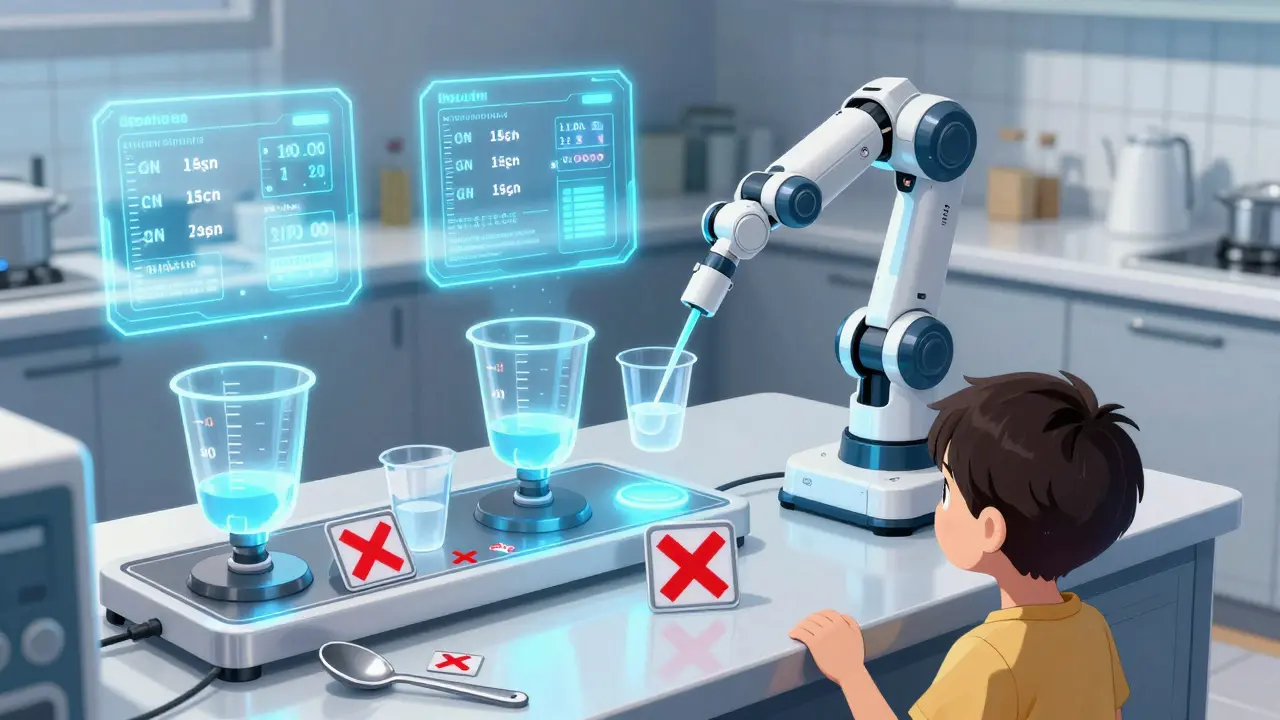
Many pediatric doses are based on weight - not age. The formula is simple: mg per kilogram per dose. But most parents measure weight in pounds. So here’s the conversion:
- 1 kilogram (kg) = 2.2 pounds (lb)
- To convert pounds to kg: divide by 2.2
Example: Your child weighs 22 pounds.
- 22 ÷ 2.2 = 10 kg
- Prescribed dose: 40 mg/kg twice a day
- 40 mg × 10 kg = 400 mg total per day
- 400 mg ÷ 2 = 200 mg per dose
- Medication concentration: 400 mg per 5 mL
- So: 200 mg = 2.5 mL per dose
If you’re unsure, ask your pharmacist to write the dose on the bottle in mL. They’re trained to do this. Don’t guess.
Common Mistakes and How to Avoid Them
- Not shaking the bottle - Leads to under-dosing. Always shake for 10 seconds before each dose.
- Using the wrong syringe - A 10 mL syringe for a 2.5 mL dose? Hard to read. Use a 1 mL or 5 mL syringe for small doses.
- Confusing mg with mL - Write it down. “200 mg” is not “2 mL.” They’re not the same.
- Using multiple caregivers - If grandma gives medicine with a spoon and mom uses a syringe, you’re setting up for error. Agree on one method.
- Not reading the label - Check the concentration. One brand of ibuprofen might be 50 mg per mL. Another is 100 mg per mL. You need to know which one you have.
What to Do If You Make a Mistake
If you gave too much - call Poison Control immediately at 1-800-222-1222. Don’t wait for symptoms. If you gave too little, don’t double the next dose. Just wait and give the right amount at the next scheduled time. Overcompensating is dangerous.
Keep a dosing log. Write down the time, dose, and tool used. It helps you track patterns and gives your doctor clear info if something goes wrong.

What’s Changing in 2026
The FDA is moving toward a new rule: all pediatric liquid medications must come with a pre-measured oral syringe marked in mL only. By 2026, nearly all pharmacies will be required to include one. That’s a big step forward. But until then, you need to be your child’s safety net.
Some new tools are already helping. Color-coded syringes (like NurtureShot) reduce errors by 61%. Smart dosing apps with augmented reality are now being tested in hospitals. But none of that matters if you’re still using a kitchen spoon.
Final Rule: When in Doubt, Ask
Pharmacists are trained to help you. Ask them to show you how to measure the dose. Ask them to write the dose in mL on the label. Ask them to give you a syringe if they didn’t. Most will. If they don’t, ask for another pharmacist.
Medication safety isn’t about being perfect. It’s about being careful. One small change - switching from a spoon to a syringe - can cut your child’s risk of harm by more than half.
Can I use a regular syringe from the pharmacy for medicine?
No. Regular syringes (like insulin syringes) are designed for injections and have different markings. They can be dangerous for oral use. Always use an oral syringe labeled for medicine. These are designed to be safe for the mouth and have clear mL markings.
What if my child spits out the medicine?
Don’t give another full dose. Instead, try giving it slowly into the side of the mouth. You can also mix it with a small spoonful of applesauce or yogurt - but only if the medicine label says it’s okay. Some antibiotics lose effectiveness if mixed. Always check with your pharmacist first.
Why do some medicine labels still say “teaspoon”?
Because not all manufacturers have updated their labels yet. The FDA and CDC recommend using mL only, but compliance is still at 78% as of 2023. If you see “tsp” or “tbsp,” ask the pharmacist to rewrite it in mL. You have the right to request this.
Is it safe to use a dosing cup for babies?
For babies under 1 year, oral syringes are safer. Dosing cups are harder to control for small volumes. A 2.5 mL dose in a cup is hard to pour accurately, and babies can’t drink from a cup yet. Use a syringe until your child is old enough to drink from a cup reliably.
Can I reuse a syringe for multiple doses?
Yes, as long as you clean it properly. Rinse with warm water after each use. Don’t use soap - it can leave residue. Let it air dry. Replace it if it becomes cracked or hard to push. A clean syringe is safe for repeated use.
Next Steps: Make It Stick
- Get an oral syringe today - even if you didn’t get one with the prescription.
- Write down your child’s weight in kg. Calculate their dose ahead of time.
- Ask your pharmacist to write the dose in mL on the bottle.
- Keep the syringe next to the medicine - not in a drawer.
- Teach everyone who gives medicine: grandma, babysitter, daycare staff.
Medication safety doesn’t require a degree. It just requires attention. One milliliter can save a life. Make sure you’re measuring it right.


13 Comments
Joanne Tan
OMG I just realized I’ve been using a teaspoon for my kid’s antibiotics 😳 I’m so glad I found this. Got an oral syringe today and it’s a game-changer. No more guessing, no more panic. Seriously, if you’re still using spoons, stop. Just stop.
Reggie McIntyre
This is the kind of post that makes me believe in humanity again 🌟
Like, imagine if every parent got this info before their first sick kid? We could cut ER visits by half. The fact that we still let people use kitchen spoons for medicine is wild. It’s like letting someone drive with a blindfold on and saying ‘just be careful.’
I’m telling all my mom friends. Also, I just bought 3 syringes-one for the car, one for grandma’s house, one for the nightstand. Pro tip: label ‘2.5 mL’ on the syringe with a Sharpie. Lifesaver.
Carla McKinney
Let’s be real-70% of caregivers mess this up? That’s not ignorance. That’s negligence. The CDC has been screaming about this since 2010. If you’re still using a tablespoon because ‘it’s easier,’ you’re not a parent-you’re a liability.
And don’t even get me started on the ‘I mixed it with applesauce’ crowd. That’s not parenting. That’s pharmaceutical roulette.
Stop making excuses. Buy the syringe. Read the label. Measure at eye level. It’s not hard. You’re not special. Your kid isn’t immune to dosage errors.
Ojus Save
bro i used a spoon for my daughter’s tylenol last week 😅
then i saw this post and went to walgreens and got a syringe. now i feel like a genius. also, i didn’t know you had to shake the bottle. mind blown.
Jonathan Noe
As a pharmacist, I see this every single day. Parents come in with a bottle, ask ‘how much is a teaspoon?’ and then look at me like I’m speaking alien.
Here’s the truth: the FDA didn’t just ‘recommend’ mL. They mandated it. But manufacturers? They drag their feet. So you have to be the adult.
And yes, you can reuse the syringe. Just rinse with water. No soap. Don’t sterilize it. Just rinse. Air dry. Done. No need to buy a new one every time.
Also-don’t use insulin syringes. I can’t tell you how many times I’ve had to explain that. Those are for needles. Not mouths. Different markings. Different risks.
Vamsi Krishna
India has been doing this right for decades. We use calibrated droppers and oral syringes. No spoons. Ever.
Why? Because our pharmacists don’t let you leave without showing you how. No ‘it’s just a teaspoon’ nonsense. We don’t romanticize ‘natural parenting’ when it could kill a child.
And guess what? Our pediatric ER admissions for medication errors? 80% lower than the US. Coincidence? I think not.
Stop pretending this is a ‘Western problem.’ It’s a failure of systems. And systems can be fixed.
Suzette Smith
Wait-so you’re saying kitchen spoons are dangerous? But my grandma used them for 40 years and I turned out fine?
athmaja biju
It is truly a disgrace that American healthcare allows such negligence. In India, every medicine bottle comes with a measuring device. We do not rely on ‘guessing’ or ‘hope.’
Why are you still using spoons? This is not a parenting choice. This is a public health failure. I am ashamed.
alex clo
Thank you for this detailed breakdown. I’ve been using a dosing cup for my 3-year-old and didn’t realize the accuracy rate was so low. I’ve switched to a 5mL syringe and will be marking the dose on it. Small changes, big impact.
Alyssa Williams
Yessss this is the info we need 💪
Got my syringe yesterday. Shook the bottle. Measured at eye level. Gave it slow to the cheek. Kid didn’t spit it out. Magic.
Also wrote the dose on the syringe with a marker. Now I don’t have to think. Just pour. Done.
PS: I told my sister. She’s using a spoon. I’m sending her this link. No mercy.
Ernie Simsek
🚨 PSA: If you’re still using a kitchen spoon, you’re playing Russian roulette with your kid’s liver.
🤯 I just found out my 18-month-old got 3x the dose last week because I used a tablespoon. I didn’t even know the difference between mg and mL.
Ordered 2 syringes. Marked them. Now I have one in the fridge and one in the diaper bag. Also downloaded a dosing app. I’m obsessed now.
Thanks for the wake-up call. I’m not just a mom-I’m a safety officer now. 😎
Jim Johnson
My kid’s pediatrician never showed me how to measure. I thought the cup that came with the medicine was enough.
Then I read this and went to CVS. Bought a 5mL syringe. Asked the pharmacist to write the dose on the bottle. She did. And even gave me a free one.
Now I keep it next to the medicine. No more guessing. No more panic. Just a simple line. That’s all you need.
Don’t wait for a crisis. Do it today. Your kid deserves that much.
Sophia Nelson
So… you’re saying I should’ve spent $5 on a syringe instead of trusting the label that says ‘use a teaspoon’? Wow. Thanks for making me feel stupid.