

When you have diabetes, your kidneys are under constant stress. Over time, high blood sugar damages the tiny filters in your kidneys, causing them to leak protein into your urine. This is called diabetic nephropathy-and it’s the leading cause of kidney failure in people with diabetes. But here’s the good news: there’s a proven way to slow it down, and it starts with two types of blood pressure medicines and one simple goal: reduce protein loss.
What Exactly Is Diabetic Nephropathy?
Diabetic nephropathy isn’t just about high blood sugar. It’s about what that sugar does to your kidneys over years. The filters in your kidneys, called glomeruli, start to break down. Instead of keeping protein inside your body, they let it spill into your urine. That’s measured as albuminuria-when you have more than 30 mg of albumin per gram of creatinine in your urine over two tests spaced three months apart, it’s a clear sign of early kidney damage.
At first, you won’t feel anything. No pain. No swelling. No symptoms. That’s why it’s called a silent disease. By the time you notice swelling in your legs or feel unusually tired, the damage may already be advanced. The real danger? Diabetic nephropathy doesn’t just hurt your kidneys-it raises your risk of heart attack, stroke, and early death.
Why Protein Control Matters More Than You Think
Reducing protein in your urine isn’t just a lab result. It’s a direct indicator that your kidneys are healing. Every time you lower that number, you’re buying time-time before dialysis, time before transplant, time to live longer.
Studies show that if you can cut proteinuria by half, you cut your risk of kidney failure by nearly 50%. That’s not a guess. That’s from large clinical trials followed over a decade. The goal isn’t to eliminate protein completely-your body needs some. But you want to get it as close to normal as possible: under 30 mg/g creatinine.
Here’s the catch: diet alone won’t do it. Cutting back on protein in your meals doesn’t significantly lower urine protein in people with diabetic nephropathy. The real power comes from medication that targets the root cause: pressure inside the kidney’s filters.
ACE Inhibitors: The First Line of Defense
ACE inhibitors-like captopril, enalapril, ramipril, and benazepril-have been used for over 20 years to protect diabetic kidneys. They work by blocking a hormone called angiotensin II, which normally tightens blood vessels and increases pressure in the kidneys.
By relaxing those vessels, ACE inhibitors lower the pressure inside the glomeruli. Less pressure means less protein leaks out. That’s why they’re not just blood pressure pills-they’re kidney protectors.
The FDA has approved captopril specifically for diabetic nephropathy, but other ACE inhibitors work just as well. The key isn’t the brand-it’s the dose. Many doctors start patients on 10 mg of benazepril or 5 mg of ramipril. But clinical trials that proved these drugs work used much higher doses: 25 mg of captopril three times a day, or 20 mg of ramipril daily.
Here’s what most doctors miss: if your creatinine rises by less than 30% after starting an ACE inhibitor, don’t stop it. That’s not kidney damage-that’s the medicine doing its job. Lowering pressure in the kidneys temporarily reduces blood flow, which raises creatinine. It’s a sign the drug is working, not failing.
ARBs: The Alternative That Works Just as Well
ARBs-angiotensin II receptor blockers-are the other half of the equation. Drugs like losartan, irbesartan, and valsartan block the same hormone as ACE inhibitors, but at a different point. They’re often used when patients can’t tolerate ACE inhibitors (usually because of a persistent dry cough).
The RENAAL and IDNT trials showed that ARBs like losartan and irbesartan cut the risk of kidney failure by 20-30% in people with type 2 diabetes and heavy proteinuria. These weren’t small studies. They followed thousands of patients for years. The results were clear: ARBs slow progression to dialysis.
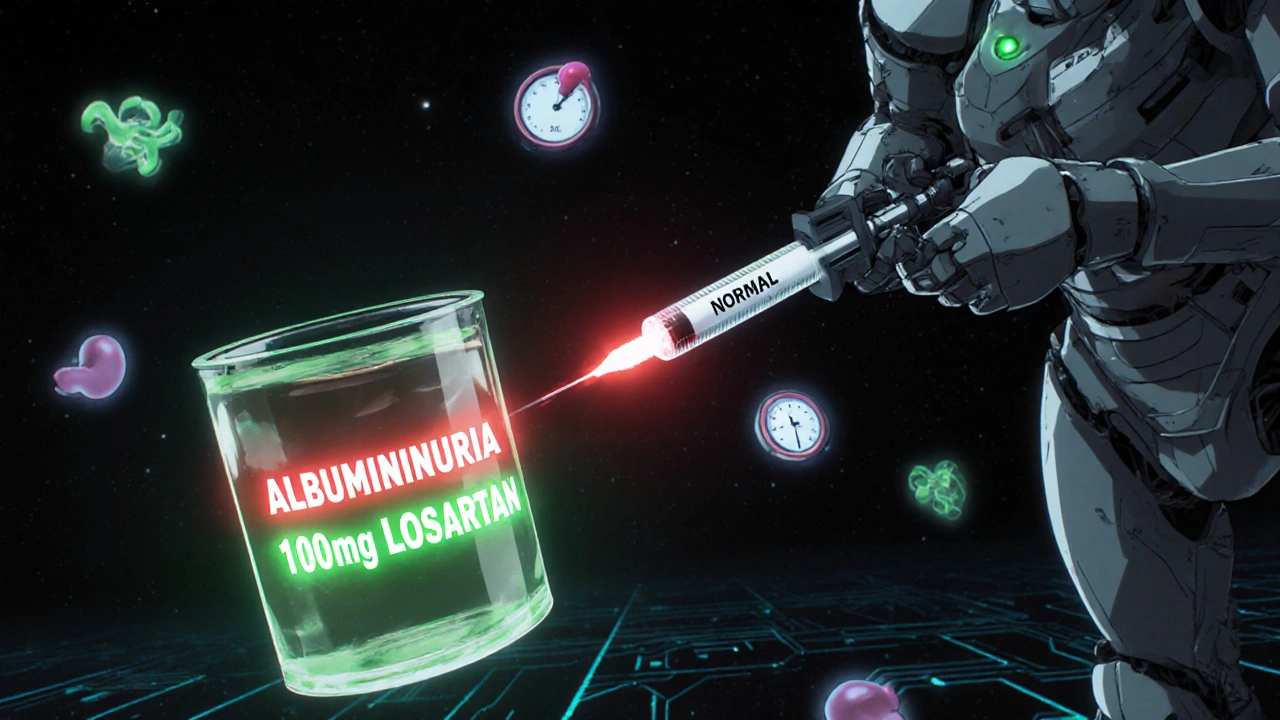
And like ACE inhibitors, the dose matters. Many patients are started on 50 mg of losartan, but the trial-proven dose was 100 mg daily. If you’re tolerating it, go higher. Low doses offer little kidney protection.
Don’t Combine ACE Inhibitors and ARBs
You might think: if one is good, two must be better. That’s not true here. Multiple large trials-VA NEPHRON-D, ONTARGET, ALTITUDE-showed that combining an ACE inhibitor with an ARB doesn’t help your kidneys anymore. But it does increase your risk of dangerous side effects.
When you combine them, your potassium can spike dangerously high (hyperkalemia), and your kidneys can suddenly shut down (acute kidney injury). These aren’t rare. They happen in up to 20% of patients on dual therapy. The risk outweighs any tiny benefit.
Same goes for adding direct renin inhibitors like aliskiren. No extra protection. Just more danger.
What About SGLT2 Inhibitors and MRAs?
You’ve probably heard about newer drugs like empagliflozin (Jardiance) or finerenone (Kerendia). These are exciting. SGLT2 inhibitors reduce blood sugar and also protect kidneys by changing how the kidney handles fluid and salt. MRAs like finerenone block a hormone that causes scarring in the kidneys.
But here’s the critical point: every major trial for these drugs was done in patients already taking an ACE inhibitor or ARB-at maximum tolerated doses. These aren’t replacements. They’re add-ons.
If you’re not on an ACE inhibitor or ARB yet, start there. Once you’re on the right dose, then talk to your doctor about adding an SGLT2 inhibitor or MRA if you’re still losing protein or your eGFR is dropping.
What If You Can’t Tolerate ACE Inhibitors or ARBs?
Some people get a dry cough. Others get dizzy or feel like they’re going to pass out. If you can’t take these drugs, you still have options.
Calcium channel blockers like amlodipine, or diuretics like hydrochlorothiazide, can help control blood pressure. But they don’t offer the same kidney protection. Beta blockers like metoprolol? They help the heart, but not the kidneys.
If you can’t take ACE inhibitors or ARBs, your best bet is an SGLT2 inhibitor. They’re the only other class proven to slow kidney disease progression in diabetes-even without RAAS blockers. But they’re not as strong. So if you can tolerate an ACE inhibitor or ARB, take it.

Why So Many Patients Are Still Under-treated
Despite decades of evidence, only about 60-70% of people with diabetic nephropathy are on these drugs. Why?
Doctors often stop them because creatinine goes up. Or because the patient is older. Or because they’re worried about potassium. Or because they think the patient “doesn’t need it yet.”
But the guidelines are clear: if you have diabetes, high blood pressure, and protein in your urine, you need an ACE inhibitor or ARB-even if your blood pressure is normal. The protection isn’t just from lowering pressure. It’s from the direct effect on kidney filters.
And if you’re over 65, or have stage 3 or 4 kidney disease, you need it even more. New data shows these drugs still work when eGFR is below 30. That’s a game-changer. We used to think they were useless in advanced kidney disease. Now we know they’re vital.
What You Should Do Right Now
If you have diabetes and haven’t had a urine test for protein in the last year, ask for one. It’s simple. A single urine sample. No fasting. No needles.
If you have protein in your urine, or an eGFR below 60, ask your doctor if you’re on an ACE inhibitor or ARB at the right dose. If you’re on one, ask: Is this the highest dose I can tolerate?
If you’re not on one, ask why not. Don’t accept vague answers like “we’ll wait and see.” The science says: start now. Dose high. Don’t stop for a creatinine rise under 30%.
And if you’re on multiple blood pressure pills, make sure your doctor isn’t adding an ARB on top of an ACE inhibitor. That’s not helping. It’s hurting.
Final Thought: It’s Not About Blood Pressure Alone
These drugs aren’t just for high blood pressure. They’re for saving your kidneys. You don’t need to be hypertensive to benefit. If you have diabetes and protein in your urine, you’re already at risk. The goal isn’t to get your blood pressure to 120/80. The goal is to get your urine protein as low as possible.
That’s how you avoid dialysis. That’s how you live longer. That’s how you take control-before your kidneys give out.




10 Comments
Gayle Jenkins
This is the kind of post that makes me want to hug my nephrologist. I’ve been on ramipril for 5 years and my albuminuria dropped from 450 to 22. No magic diet, no miracle supplements-just the right dose and refusing to let my doctor downsize it because my creatinine went up 25%. They tried to take me off. I didn’t let them. My kidneys are still working. And I’m still hiking.
Stop treating this like a suggestion. It’s a lifeline.
steve stofelano, jr.
It is with profound respect for the scientific literature and clinical rigor that I acknowledge the unequivocal efficacy of angiotensin-converting enzyme inhibitors and angiotensin receptor blockers in the management of diabetic nephropathy. The evidence base, as elucidated in the RENAAL and IDNT trials, remains robust and compelling. It is imperative that practitioners adhere to guideline-directed therapy, particularly in light of the demonstrated reduction in end-stage renal disease progression.
Furthermore, the cautionary note regarding dual RAAS blockade is not merely prudent-it is essential to patient safety. The risk-benefit ratio is unequivocally unfavorable in this context.
Savakrit Singh
Bro this is FIRE 🔥 but wait… why no mention of SGLT2i as first line now? 🤔 I mean like… Jardiance is literally changing the game. Also, creatinine rise = good? 😳 My doc still panics when it goes up 10%. I’m just sayin’… maybe we need to update the manual? 📚💀
Also, 100mg losartan? I’m on 50. Is my kidney crying? 😭
Cecily Bogsprocket
I used to think kidney damage was just a slow fade. But this? This is like watching your house get flooded by a leak you didn’t know was there-until you see the mold. And then someone hands you a bucket and says, ‘Here, this is how you bail.’
It’s not about being perfect. It’s about showing up. Taking the pill. Asking the question. Not letting fear of side effects silence you. I’ve seen people die because they waited for ‘the right time.’ There is no right time. There’s only now.
And if your doctor says ‘we’ll wait’-ask them when they’d start if it was their kidney. If they hesitate, you already know the answer.
Don’t wait until you’re tired all the time. Don’t wait until your legs swell. Don’t wait until the dialysis machine becomes your second home. Start now. Even if you feel fine. Especially if you feel fine.
Because the silence isn’t peace. It’s the calm before the storm.
Jebari Lewis
Just a quick note-my doc started me on 5mg ramipril and said ‘we’ll see how you do.’ I looked up the trial doses. I came back with the paper. He was surprised. I’m now on 20mg. Creatinine went up 22%. He was worried. I said, ‘That’s the drug working, not failing.’ He nodded. I’m still here. Kidneys intact.
Also, SGLT2 inhibitors? YES. But they’re not magic. They’re the bonus round. You need the ACE/ARB foundation first. Don’t skip the base. I’ve seen too many people jump straight to the new drugs and wonder why their protein didn’t drop.
And yes, I typed this on my phone. Sorry for the typos. But the message? Crystal clear.
Emma louise
Oh wow. A medical post that doesn’t end with ‘consult your doctor.’ Groundbreaking.
So let me get this straight-you’re telling me the same drugs that make me cough like I’m dying and give me dizzy spells are somehow ‘kidney protectors’? And we’re supposed to just power through it because some 20-year-old study says so?
Meanwhile, my cousin took turmeric and her A1C dropped. Coincidence? Maybe. But I’ll take my herbal tea over a $300 pill that makes me feel like a zombie.
Also, why are we still using 1990s meds? Where’s the Apple kidney patch? 🤷♀️
sharicka holloway
I’m 68, type 2 for 22 years, and I’ve been on lisinopril for 15. My doc told me I didn’t need it because my BP was normal. I cried in the parking lot. Then I went back and asked him to read the paper again. He did. He changed his mind.
This isn’t about being perfect. It’s about being present. Taking the pill. Asking the question. Not letting fear win.
If you’re reading this and you’re scared? I get it. But you’re not alone. We’re all just trying to keep our bodies from falling apart. One pill, one test, one conversation at a time.
Alex Hess
Look, I read the abstract. I skimmed the trials. This is just standard RAAS blockade stuff. Nothing new. The fact that this is even a discussion shows how behind the curve most clinicians are. Also, why are we still talking about ACE inhibitors like they’re the holy grail? We’ve got SGLT2is, GLP-1s, MRAs-this is 2025, not 2005.
And ‘don’t combine ACE and ARB’? Really? That’s your big revelation? My 3rd-year med student could’ve told you that.
Also, why is everyone acting like this is some profound insight? It’s textbook. Boring.
Lauren Zableckis
Thank you for writing this. Not everyone gets how scary this is-how quiet it is until it’s too late. I didn’t know I had protein in my urine until my sister, a nurse, made me get tested after I said I was ‘just tired.’
I’m on 100mg losartan now. My creatinine went up 28%. I didn’t panic. I trusted the science. I’m still here. Still walking my dog. Still laughing.
Don’t let fear silence you. Ask. Push. Stay.
Asha Jijen
this is so important i wish more people knew this my uncle died from kidney failure he was on metformin only and no bp meds he thought he was fine cause he felt ok but his urine test was all over the place and no one told him till it was too late