
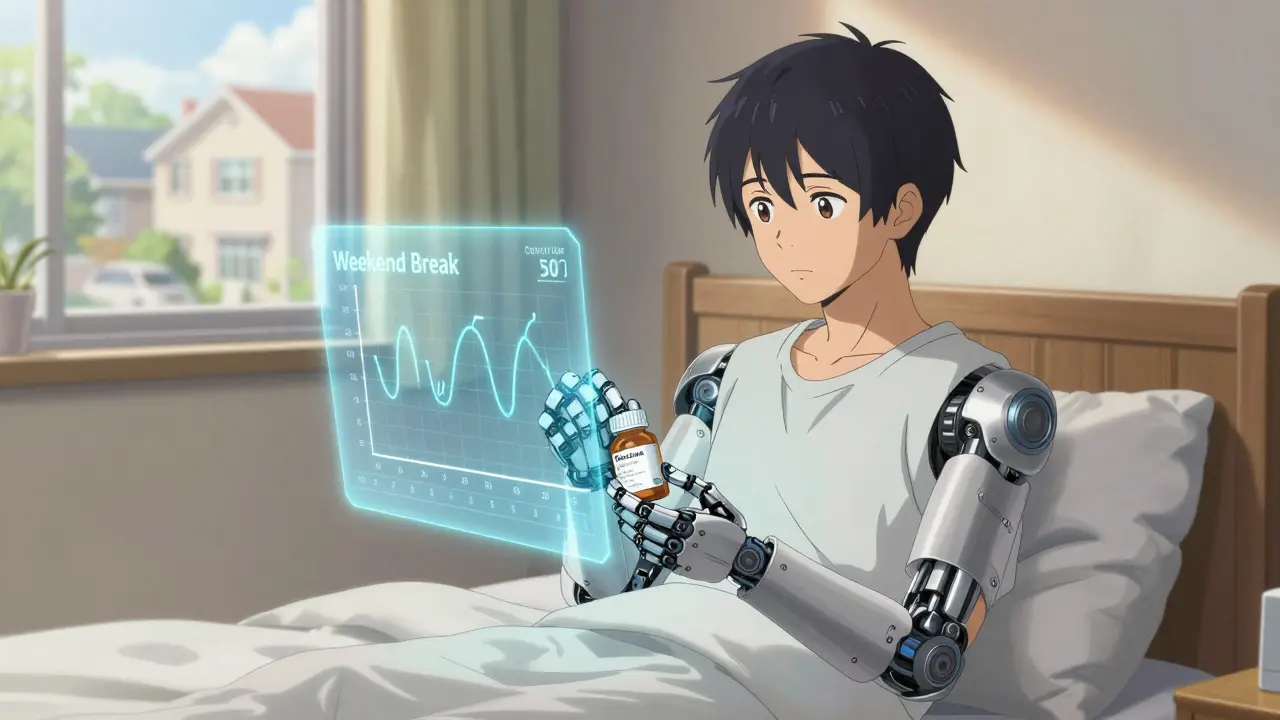
Drug Holiday Safety Checker
Check Your Medication Safety
Select your medication to see if a medically supervised break is generally safe based on clinical evidence.
Medication has long half-life (4+ days) and low withdrawal risk
Medication has moderate half-life; requires careful planning
Medication must be taken daily; abrupt stop risks serious harm
Most people assume if a doctor prescribes a medication, you take it every day, no exceptions. But what if taking a break could actually help - not hurt - your health? Drug holidays aren’t about skipping pills because you forgot or felt lazy. They’re planned, temporary pauses in medication use, guided by a doctor, designed to manage side effects, reset your body’s response, or improve quality of life. For some people, they’re a lifeline. For others, they’re dangerous. The difference? How they’re done.
What Exactly Is a Drug Holiday?
A drug holiday is a medically supervised break from a prescribed medication. It’s not quitting cold turkey. It’s not guessing when to restart. It’s a structured plan, often with specific start and end dates, built around your health goals. The idea isn’t new - it started showing up in HIV treatment in the 1990s - but early hopes that skipping drugs might boost immunity were quickly crushed by science. The 2006 SMART trial, which tracked over 5,000 HIV patients, found those who took breaks had a much higher risk of infections, heart problems, and even death. That ended drug holidays for HIV. But for other conditions? The story’s different.Where Drug Holidays Actually Work
The best evidence for safe drug holidays comes from mental health. For people on SSRIs - medications like fluoxetine (Prozac), sertraline (Zoloft), or escitalopram (Lexapro) - sexual side effects are one of the most common reasons people stop taking them. Studies show up to 65% of users experience reduced libido, delayed orgasm, or erectile dysfunction. A weekend break - skipping the pill Friday night through Sunday night - can help. Fluoxetine, with its long half-life (4-6 days), stays in your system long enough that a 48-hour pause rarely triggers withdrawal. Patients report improved intimacy without mood crashes. One user on PatientsLikeMe said, “Two days off Prozac restored intimacy without noticeable mood changes.” Another area where drug holidays are still used, though controversially, is ADHD treatment in children. Stimulants like methylphenidate (Ritalin) and amphetamine (Adderall) are highly effective in school, but many parents worry about long-term effects on growth or just want their kids to have a “normal” summer. Summer breaks - often 8 to 12 weeks - are common. But here’s the catch: 78% of children experience a rebound in symptoms. Their impulsivity spikes. They struggle in camp, with friends, even at home. One parent on Reddit described her 10-year-old’s summer as “complete vacation sabotage,” leading to three ER visits. The Child Mind Institute found kids on year-round treatment had 37% better social functioning and 29% fewer behavioral incidents outside school.When Drug Holidays Are Dangerous
Not all medications can handle a break. Some drugs need to be in your system every single day. Stop them suddenly, and you risk serious harm. - Beta-blockers (like metoprolol): Stopping abruptly can trigger a heart attack or dangerous spike in blood pressure. - Anticonvulsants (like lamotrigine, valproate): Missing even one dose can trigger seizures in people with epilepsy. - Corticosteroids (like prednisone): Your body stops making its own cortisol. Stopping suddenly can cause adrenal crisis - low blood pressure, vomiting, shock, even death. - Short-acting antidepressants (like paroxetine or venlafaxine): These leave your system fast. Withdrawal can mean brain zaps, dizziness, nausea, or intense anxiety. One in four users on Drugs.com reported these symptoms during unplanned breaks. The NCBI’s 2021 review of 347 cases found that 68% of successful drug holidays used clear protocols. Only 22% of unplanned or poorly planned breaks worked. The difference? Planning.
Why Half-Life Matters
The key to whether a drug holiday is possible lies in pharmacokinetics - how your body processes the drug. Drugs with long half-lives stay in your system longer. Fluoxetine’s half-life is 4-6 days. That means even if you skip a dose, enough remains to prevent withdrawal. Paroxetine? Half-life of 21 hours. You’ll feel the drop fast. Venlafaxine? Just 5 hours. A missed dose can trigger withdrawal symptoms by lunchtime. This is why fluoxetine is the go-to for weekend breaks. It’s forgiving. Paroxetine? Not even close. Doctors use this science to decide who can safely pause. It’s not one-size-fits-all. It’s chemistry.What Experts Say
Dr. Michael Craig Miller from Harvard Health says drug holidays can “give the body a chance to recover systems suppressed by the drug.” That’s true - especially for medications that cause receptor downregulation. Over time, your brain gets used to high serotonin levels from SSRIs. A short break might help reset sensitivity. But Dr. Alan Ravitz from the Child Mind Institute warns: “For ADHD, the risks almost always outweigh the benefits.” His data shows children off stimulants during summer have a 45% higher chance of accidents, poor decision-making, and emotional outbursts. One mother shared that her son’s baseball coach noticed his performance plummeting - and his self-esteem crashed along with it. He went back on medication by August. Dr. David Healy’s 2020 meta-analysis found 33% of people with a history of multiple depressive episodes relapsed within 14 days of stopping antidepressants. That’s not a gamble most people should take.How to Do a Drug Holiday Right
If you’re considering a break, here’s how to do it safely:- Wait at least 6 months after your symptoms are stable. Jumping off too soon raises relapse risk.
- Track your symptoms for 4-8 weeks before stopping. Use a journal or app. Note mood, sleep, energy, side effects.
- Choose the right drug. Only consider breaks for medications with long half-lives and low withdrawal risk. Avoid anything listed as dangerous to stop abruptly.
- Plan the timing. For SSRIs, weekend breaks (Friday to Sunday) work best. For ADHD, summer breaks are common but require close monitoring.
- Set clear return triggers. What signs mean you need to restart? Irritability? Trouble sleeping? Poor focus? Write them down.
- Use gradual tapering if possible. Instead of skipping a full day, reduce the dose by 25% for a few days first.
- Have a backup plan. Know who to call if things go wrong. Keep your doctor’s number handy. Tell family members what to watch for.



14 Comments
Janette Martens
so like... if i skip my antidepressants on weekends i become a better canadian? lol. also i typoed half the time but u get the point. my dog even notices when i’m on prozac vs off. he’s more chill when i’m zombified.
Marie-Pierre Gonzalez
Thank you for this thoughtful and meticulously researched exposition on pharmacological discontinuation protocols. While the concept of therapeutic pauses holds merit in select clinical contexts, the ethical imperative to prioritize patient safety cannot be overstated. I urge all readers to consult their prescribing physician prior to any deviation from established regimens. 🙏
Louis Paré
Let’s be real - drug holidays are just a fancy way for people to self-medicate their laziness. If you can’t handle your meds, maybe you shouldn’t be on them. Also, the whole ‘weekend break’ thing? That’s not science. That’s someone who doesn’t want to feel human on Monday mornings. The SMART trial proved this is a death sentence for some. Yet here we are, romanticizing it like it’s a spa day.
Vu L
bro what if the real drug holiday is just not taking meds at all? like… why are we even having this conversation? maybe your brain just needs to chill and not be chemically neutered.
James Hilton
So let me get this straight - you’re telling me I can skip my Zoloft on Friday night and still have sex without crying into my nachos? 🤯 I’m booking my weekend break right now. Thanks, science.
Mimi Bos
i read this whole thing and still don’t know if i can skip my ritalin this summer. my mom says yes. my doctor says no. my therapist says ‘it’s complicated.’ so… yeah.
Payton Daily
Okay but think about it - what if the whole system is just programmed to keep us medicated? Big Pharma doesn’t want you to feel *natural*. They want you dependent. Like, think about it: if you stop taking your pills, you might actually have to face your trauma. And who wants that? Not me. Not anyone. We’d rather just have a chemical vacation. 🤔
Kelsey Youmans
While the clinical data presented is compelling, particularly regarding the risks associated with abrupt discontinuation of corticosteroids and anticonvulsants, I remain concerned about the potential for misinterpretation by non-clinical audiences. The nuanced distinction between planned, monitored pauses and self-initiated cessation must be communicated with greater clarity to prevent harm.
Sydney Lee
It’s tragic. People treat their brain chemistry like a smartphone battery - ‘I’ll just turn it off for a bit.’ You don’t get to reboot your serotonin like you reboot your router. And yet, here we are, in a culture that believes if you feel bad, you just need to ‘unplug’ - as if your neurochemistry were a Wi-Fi signal. You can’t ‘take a break’ from being human. You can only run from it - until it catches up.
Gran Badshah
in india we don’t do drug holidays. we just stop taking meds and pray. sometimes it works. sometimes you end up in hospital. sometimes you die. but hey, at least you saved money on pills.
Ellen-Cathryn Nash
I’m sorry, but if you’re using your child’s summer break to ‘test’ their ADHD meds, you’re not being a parent - you’re being a lab rat operator. That’s not freedom. That’s negligence wrapped in a ‘let them be kids’ bow. And then you wonder why they’re in therapy at 16.
Samantha Hobbs
my therapist said i could try a 3-day break on my lexapro. i did. i cried for 48 hours straight. then i took the pill again. now i’m mad at myself for even trying. why do we think we know better than the science??
Nicole Beasley
whoa. this is so eye-opening 🤯 i never realized half-life mattered so much. now i get why my friend’s paroxetine made her feel like she was being zapped by a toaster every time she missed a dose. 💥 i’m sharing this with my whole group chat.
Hakim Bachiri
Look - I’m not saying drug holidays are bad. I’m saying the people who push them are. The ‘weekend reset’ crowd? They’re the same ones who think yoga fixes depression and ‘manifesting’ cures anxiety. This isn’t self-help, it’s pharmacology. And if you’re not reading peer-reviewed journals before you skip your meds… you’re not brave. You’re just reckless. And I’m tired of your ignorance being treated like wisdom.