

When you pick up a generic pill at the pharmacy, you expect it to work just like the brand-name version. But how do regulators know it’s truly the same? The answer lies in pharmacokinetic studies-the most common, and often misunderstood, tool used to prove that generics are safe and effective substitutes. These aren’t just paperwork exercises. They’re tightly controlled human trials that measure exactly how your body handles the drug. And while they’re not perfect, they’re the backbone of every generic drug approved in the U.S. and most of the world.
What Pharmacokinetic Studies Actually Measure
Pharmacokinetics, or PK, is the science of what your body does to a drug. It answers three basic questions: How fast does the drug enter your bloodstream? How much gets in? And how long does it stay there?
To find out, researchers give volunteers either the brand-name drug or the generic version, then take frequent blood samples over several hours. They measure two key numbers: AUC (area under the curve) and Cmax (peak concentration).
- AUC tells you how much of the drug your body absorbs overall-the total exposure.
- Cmax shows you how quickly it reaches its highest level in your blood-the rate of absorption.
For a generic drug to be approved, the 90% confidence interval for both AUC and Cmax must fall between 80% and 125% of the brand-name drug’s values. That’s not a guess. It’s a statistical rule set by the FDA since 1984 under the Hatch-Waxman Act. This range isn’t arbitrary. It’s based on decades of data showing that differences outside this range can lead to real clinical effects-either reduced effectiveness or increased side effects.
Why Healthy Volunteers? And Why Crossover Design?
You won’t find sick patients in these studies. Instead, researchers use 24 to 36 healthy adults. Why? Because they want to isolate how the drug behaves in the body without interference from disease, other medications, or metabolic issues.
The study design is called a crossover: each volunteer takes both the brand and the generic, separated by a washout period. This cuts out individual variation. If one person naturally absorbs drugs slowly, they’ll absorb both versions slowly. The comparison becomes clean: drug A vs. drug B in the same person.
Studies are done under two conditions: fasting and after eating. Why? Because food changes how some drugs are absorbed. A drug like itraconazole, for example, needs food to work properly. If the generic behaves differently with food than the brand, it gets rejected.
Not All Drugs Are Created Equal
PK studies work brilliantly for simple, immediate-release pills taken by mouth-like ibuprofen or metformin. In fact, fewer than 2% of these generics fail bioequivalence testing after approval, according to FDA post-market data.
But things get messy with complex drugs. Take topical creams, inhalers, or injectables. You can’t measure drug levels in the blood and assume they reflect what’s happening in the skin or lungs. A cream might look identical on paper, but if the active ingredient doesn’t penetrate the skin the same way, it won’t work.
For these, regulators are turning to alternatives:
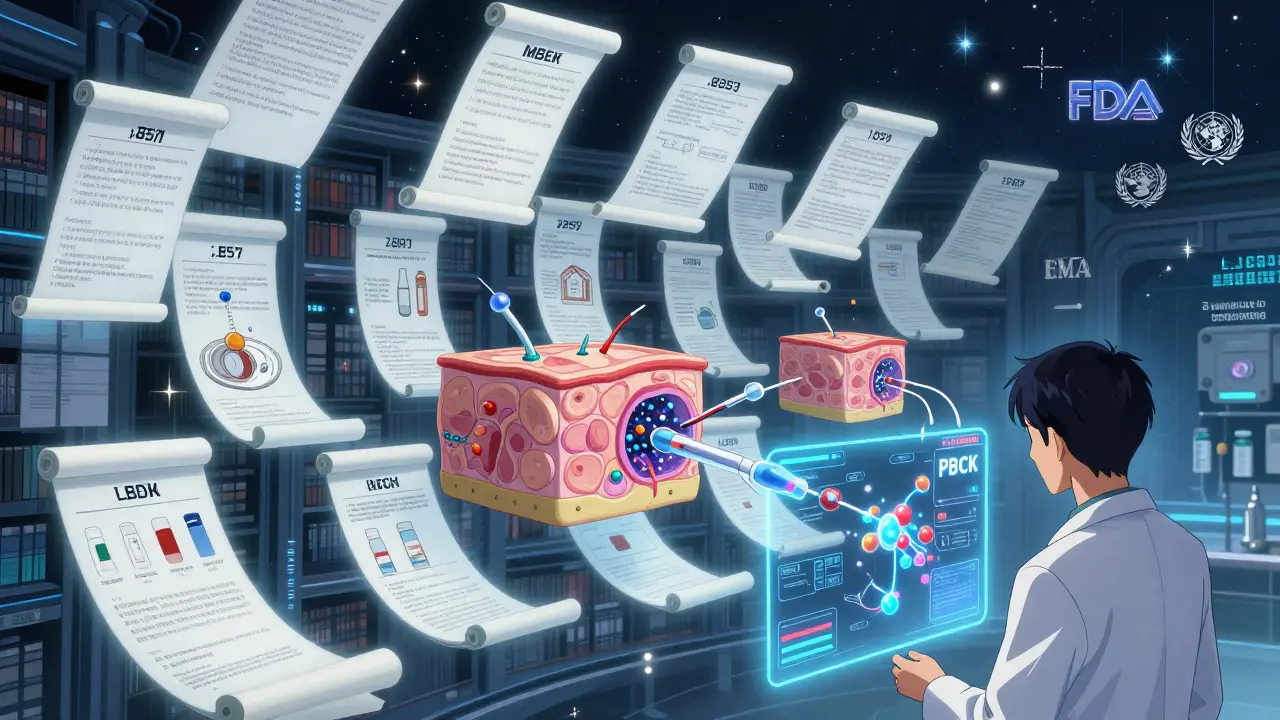
- In vitro permeation testing (IVPT): Uses human skin samples to see how much drug passes through.
- Dermatopharmacokinetics (DMD): Measures drug levels directly in the skin using microdialysis.
- Physiologically-based pharmacokinetic (PBPK) modeling: Computer simulations that predict how a drug behaves based on its chemistry and human physiology.
The FDA now has over 149 product-specific guidances for complex drugs-meaning each one gets its own custom testing plan. There’s no one-size-fits-all anymore.

The Narrow Therapeutic Index Problem
Some drugs have razor-thin safety margins. Warfarin, phenytoin, levothyroxine, digoxin-these are life-or-death medications. A 5% difference in absorption could mean a stroke or a seizure.
For these, the FDA tightened the rules. The acceptable range for AUC and Cmax isn’t 80-125% anymore. It’s narrowed to 90-111%. Some drugs even require additional clinical monitoring.
And here’s the kicker: even with identical ingredients and perfect PK studies, some generics still fail in real-world use. A 2010 PLOS ONE study found that two generics from reputable manufacturers showed statistically different effects in patients-even though their PK profiles matched the brand. Why? Because PK studies measure blood levels, not clinical outcomes. Sometimes, the body responds differently to minor formulation differences that aren’t visible in plasma.
Cost, Time, and the Hidden Hurdles
Running a single bioequivalence study costs between $300,000 and $1 million. It takes 12 to 18 months. That’s why many small companies can’t afford to make generics for complex drugs.
Manufacturers face brutal trade-offs. A tiny change in an inactive ingredient-a different filler, coating, or binder-can alter how fast the drug dissolves. Even if the active ingredient is exactly the same, the body may absorb it slower or faster. That’s why the FDA requires dissolution testing: the generic must release its drug within 10% of the brand’s rate in simulated stomach fluid.
And here’s something few people realize: the FDA has 1,857 active product-specific guidances as of 2023. That means each generic drug has its own rulebook. There’s no universal checklist. You can’t just copy-paste a study from one drug to another.
Is Pharmacokinetics Really the Gold Standard?
The FDA doesn’t call it a gold standard. They say bioequivalence is a principle-not a guarantee. And they’re right.
Pharmacokinetic studies are the best tool we have for most drugs. But they’re a surrogate. They measure blood levels, not how you feel, how your blood pressure changes, or whether your seizure frequency drops.
For some drugs, in vitro tests or modeling are proving more reliable. A 2009 PMC paper even argued that for certain immediate-release pills, lab-based tests outperformed human trials in consistency.
Global regulators disagree too. The European Medicines Agency (EMA) uses stricter, more rigid rules than the FDA. Some countries still rely on clinical trials. Others accept in vitro data. The WHO says therapeutic equivalence can be proven in multiple ways-PK studies are just the most common.
What This Means for You
If you take a generic drug for high blood pressure, diabetes, or depression, you’re almost certainly getting something that behaves just like the brand. The system works. Over 95% of generic approvals in 2022 used PK studies-and nearly all succeeded.
But if you’re on a narrow therapeutic index drug, pay attention. Talk to your pharmacist. If you notice a change in how you feel after switching generics, report it. The system relies on real-world feedback.
And if you’re switching from brand to generic for cost reasons-you’re not sacrificing safety. The science behind these studies is rigorous. But it’s not magic. It’s measurement. And measurement, even when precise, can miss what’s happening inside your body.
Are generic drugs always as effective as brand-name drugs?
For most drugs, yes. Pharmacokinetic studies ensure that the generic delivers the same amount of active ingredient into your bloodstream at the same rate as the brand. The FDA approves over 95% of generic drugs using this method. But for drugs with a narrow therapeutic index-like warfarin or levothyroxine-some patients may notice differences. If you feel different after switching, talk to your doctor.
Why do some generics cost so much less if they’re the same?
Brand-name companies spend billions on research, clinical trials, and marketing. Generic manufacturers don’t have to repeat those studies. They only need to prove bioequivalence-which costs a fraction of the original development. That’s why generics can be 80-85% cheaper. The active ingredient is identical. The savings come from cutting out the upfront costs of discovery and approval.
Can a generic drug fail even if it looks identical to the brand?
Yes. Two generics can have the same active ingredient, strength, and appearance, but differ in inactive ingredients like fillers or coatings. These can change how fast the drug dissolves in your stomach. Even if the PK study passes, some patients report different effects. That’s why the FDA requires dissolution testing and why some drugs have product-specific guidelines.
Do all countries use the same bioequivalence standards?
No. The U.S. FDA, European EMA, and WHO have different approaches. The FDA is more flexible and product-specific, while the EMA uses stricter, uniform rules. Some countries accept in vitro tests for simple drugs; others require full human trials. The International Council for Harmonisation (ICH) is working to align these, but global standards still vary.
What’s the future of bioequivalence testing?
The field is moving beyond blood tests. For topical drugs, skin-level measurements are replacing human trials. For oral drugs, computer models (PBPK) are being used to predict absorption without testing in people. The FDA already accepts PBPK models for certain drugs. In the next decade, we may see fewer human studies and more lab-based or simulated data-faster, cheaper, and sometimes more accurate.



10 Comments
Anil bhardwaj
Been using generics for years, never had an issue. My blood pressure med? Totally fine. Even saved a few bucks every month. Honestly, if it works, why overthink it?
lela izzani
It’s wild how much science goes into something most people treat like a commodity. The 80-125% range isn’t random-it’s based on real clinical data. And the fact that they test fasting AND fed states? That’s thorough. Most folks don’t realize how much goes into making sure a $5 pill does the same job as a $50 one.
Nerina Devi
As someone who’s been on levothyroxine for over a decade, I’ve switched generics three times. Each time, I felt off for a week-fatigue, brain fog, mood swings. My endo said it’s not uncommon. We now stick to one brand, even if it costs more. The science says they’re equivalent. But bodies aren’t lab rats. Real people feel the difference.
Pharmacokinetics measures blood levels. It doesn’t measure how your thyroid feels. Or how your anxiety spikes. Or how your hair keeps falling out. Those are real consequences. The system works for most. But for the 5% who aren’t ‘most,’ it’s not enough.
Vanessa Drummond
Oh please. The FDA is just protecting Big Pharma’s bottom line. If generics were truly identical, why do they need 1,857 separate guidances? That’s not science-that’s bureaucracy. And don’t even get me started on dissolution testing. Some of these ‘identical’ pills dissolve in 20 minutes, others in 45. You think that doesn’t matter? Try taking one on an empty stomach and then after a greasy burger. Your body notices. Your doctor doesn’t.
And don’t give me that ‘95% success rate’ crap. What about the 5% who end up in the ER? You think they’re just unlucky? No. They’re the canaries in the coal mine.
Shalini Gautam
India makes 40% of the world’s generic drugs. We don’t cut corners. We engineer them. The US thinks it’s the only one that knows science? Please. Our labs are ISO-certified, our workers are trained, and our inspectors are stricter than you think. If you’re having issues with a generic, it’s probably not the drug-it’s the pharmacy that repackaged it. Or your doctor didn’t check the batch number.
And yes, we know about narrow therapeutic index drugs. We don’t export those to the US without triple-testing. You think we’d risk our reputation? We’re the pharmacy of the developing world. We can’t afford to mess up.
Steven Pam
I love how this post breaks down the science without dumbing it down. Seriously, kudos. The crossover design? Genius. Same person, two drugs, washout period-it’s like a blind taste test but for your bloodstream. And the food testing? So many people don’t realize that a pill isn’t just a pill. It’s a chemical dance with your stomach acid, bile, enzymes… it’s wild.
Also, PBPK modeling is the future. Why stick needles in people when a computer can simulate it? We’re already doing this for cancer drugs. In 10 years, we’ll look back at human PK trials like we look back at dial-up internet.
Timothy Haroutunian
Let me just say this: I’ve read this entire post three times and I still don’t understand why we don’t just use the brand name if it’s so much more reliable. I mean, if a generic can fail in real-world use even after passing all the tests, then what’s the point? It’s like buying a ‘certified pre-owned’ car that’s been in three accidents but passed the inspection. The inspection was wrong.
And why do we need 1,857 guidances? That’s not a system-that’s a nightmare. Imagine trying to build a IKEA bookshelf with 1,857 different instruction manuals. You’d give up and just buy a new one. Why not do the same with drugs? Pay the extra $10 and get peace of mind? I’m not a scientist, but I know when I’m being sold a bill of goods.
Also, who tests the testers? Who checks if the labs are doing their job right? Who audits the bioequivalence studies? Because if the system is this fragile, then the whole thing is built on sand.
And let’s not pretend that ‘80-125%’ is some magic number. That’s a 45% window. If I told you your blood sugar could be 45% higher or lower and you’d be fine, you’d laugh. But we accept this for life-saving drugs? That’s not science. That’s gambling.
And why are healthy volunteers used? Because sick people are too complicated? Then why are we giving these drugs to sick people? It doesn’t make sense. It’s like testing a parachute on a skydiver who’s never jumped before. You’re not testing the parachute-you’re testing the jumper.
I’m not anti-generic. I’m pro-truth. And the truth is: we’re flying blind.
Erin Pinheiro
ok so i read this and im like wow but then i thought wait if the range is 80-125% then what if the generic is 79%? does it just get rejected? or is there like a grace period? and also i heard that some generics have different fillers and like one time i took one and i got a rash? was that the drug or the filler? also why do they use healthy people? like if i have anxiety and i take a drug for it, shouldnt they test it on people like me? and also i read that the ema is stricter but like why? are they just being extra? also the word pharmacokinetic is so hard to spell i always write pharmacokinetik and im not even trying to be funny
Brandice Valentino
Ugh. I can’t believe we’re still using blood draws to test equivalence. It’s 2024. We have AI, microfluidics, CRISPR, and we’re still sticking needles into healthy college kids for $500 a pop? How quaint. PBPK modeling has been validated since 2016. The FDA even approved a drug based solely on simulation last year. Yet here we are, clinging to 1980s methods like it’s some sacred ritual. It’s not science-it’s inertia. And don’t even get me started on the ‘crossover design.’ It’s statistically elegant, sure. But humans aren’t machines. Your metabolism changes. Your gut flora shifts. Your sleep’s off. You had a latte that morning. None of that matters? How arrogant.
And the 80-125% range? That’s not a standard. It’s a compromise. A political one. Made by bureaucrats who didn’t want to shut down the generic industry. It’s not about safety. It’s about cost. And we’re all just pretending it’s science.
Larry Zerpa
Let’s be clear: bioequivalence is a myth. It’s not a scientific standard-it’s a regulatory fiction. The 90% confidence interval between 80-125%? That’s a statistical loophole, not a biological truth. You can have two drugs with identical AUC and Cmax values, yet one causes arrhythmias and the other doesn’t. Why? Because PK measures concentration, not effect. It ignores receptor binding, protein binding, metabolite activity, tissue distribution, and epigenetic modulation.
And the FDA’s ‘product-specific guidances’? They’re not guidance-they’re a patchwork of exceptions. It’s like saying ‘all cars must meet safety standards’ but then having 1,857 different rules for sedans, SUVs, trucks, and electric scooters. That’s not regulation. That’s chaos.
And the fact that some generics fail in real-world use despite passing PK? That’s not a footnote-it’s the headline. We’re not testing whether the drug works. We’re testing whether it looks like it works in a controlled lab. That’s not equivalence. That’s theater.
Stop calling this science. It’s compliance. And we’re all just actors in a play where the script was written by lawyers.