
When you pick up a prescription at the pharmacy, you might not think twice about whether it’s a brand-name drug or a generic. But doctors in different countries see generics in wildly different ways - not because of the medicine itself, but because of how their healthcare systems work, what they can afford, and what they’ve been trained to trust.
Europe: Generics as a Policy Tool
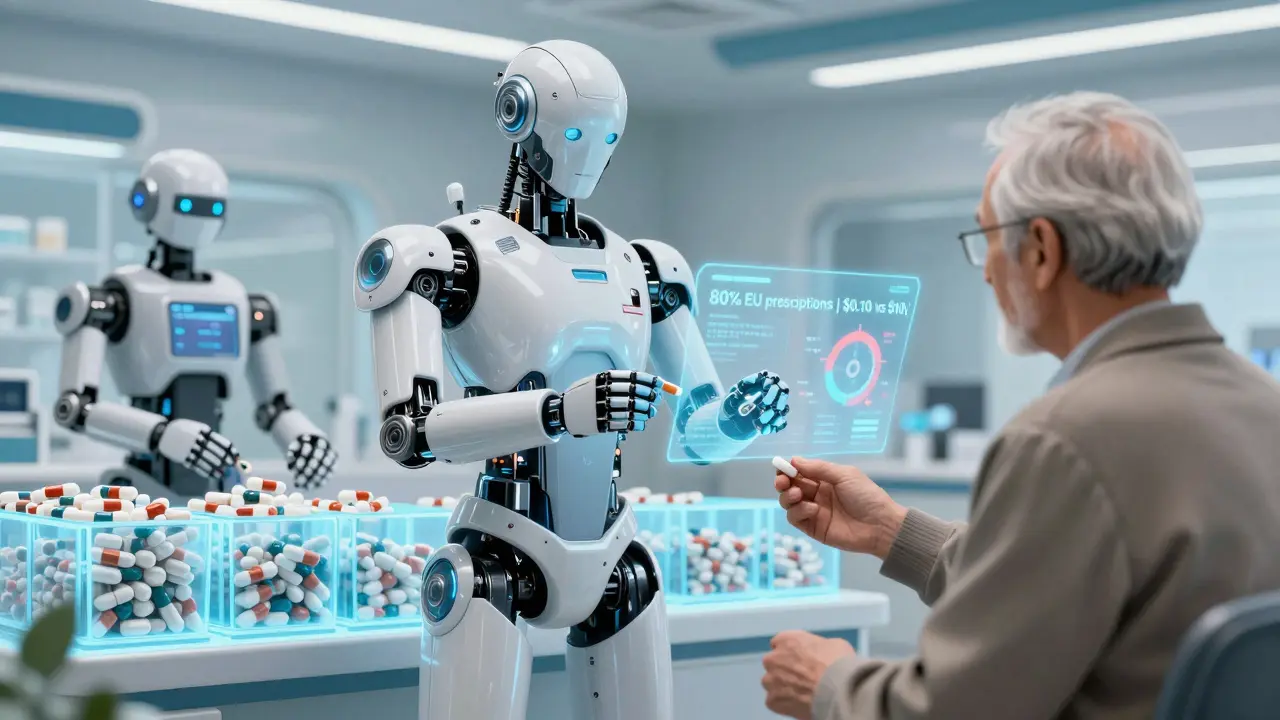
In Germany, France, and the UK, doctors don’t just accept generics - they’re encouraged to prescribe them. Government policies make it easy. Pharmacists can swap a brand-name drug for a generic without asking the doctor, and in many cases, they’re required to. This isn’t about cutting corners; it’s about keeping the system running. European healthcare budgets are tight, and generics save billions each year. A 2025 report showed that generics make up nearly 80% of prescriptions across the EU, even though they only account for about 25% of total drug spending. That’s because a generic pill might cost $0.10 instead of $10. Doctors there aren’t skeptical. They’ve seen the data. Generics work the same. They’ve watched patients stick to their treatment plans because the cost is low. In fact, many European physicians now start with generics as the default - unless there’s a clear reason not to, like a rare allergy or a complex formulation that hasn’t been replicated yet.India and Asia-Pacific: Generics as Lifelines
In India, generics aren’t just affordable - they’re the backbone of public health. Over 20% of all generic drugs made globally come from Indian factories. Indian doctors don’t debate whether to prescribe them. They ask: Which generic do we use today? The country’s population is aging fast, diabetes and heart disease are rising, and out-of-pocket costs for medicine can be devastating. Generics are the only way millions can stay alive. Doctors in China and Thailand see it the same way. Government programs actively push generic use. In rural clinics, a patient might get a generic version of a blood pressure pill that costs less than a cup of tea. There’s no stigma. No hesitation. Generics are trusted because they’re everywhere - and they work. And it’s not just local use. India supplies about 40% of the generic drugs used in the United States. That means when you take a generic statin or antibiotic in America, there’s a good chance it was made in a factory in Hyderabad or Chennai.United States: The Double Standard
In the U.S., generics are everywhere - 90% of prescriptions are filled with them. But here’s the twist: doctors know the system is broken. Generics save patients money, yes - but they also expose how fragile the supply chain is. A doctor in Ohio might prescribe a generic antibiotic, only to find out two weeks later that it’s out of stock. Why? Because the manufacturer in China had a quality issue. Or because the raw ingredient from India was delayed. These shortages aren’t rare. They happen monthly in some drug categories. U.S. providers also worry about quality. Not because generics are inherently unsafe - they’re held to the same FDA standards as brand-name drugs - but because some low-cost manufacturers cut corners. There have been scandals: contaminated pills, false test results, facilities shut down by regulators. That erodes trust. Still, most American doctors agree: generics are necessary. With insulin costing $300 a vial and cancer drugs hitting $10,000 a month, there’s no alternative. The real issue isn’t whether generics work - it’s whether the system can reliably deliver them.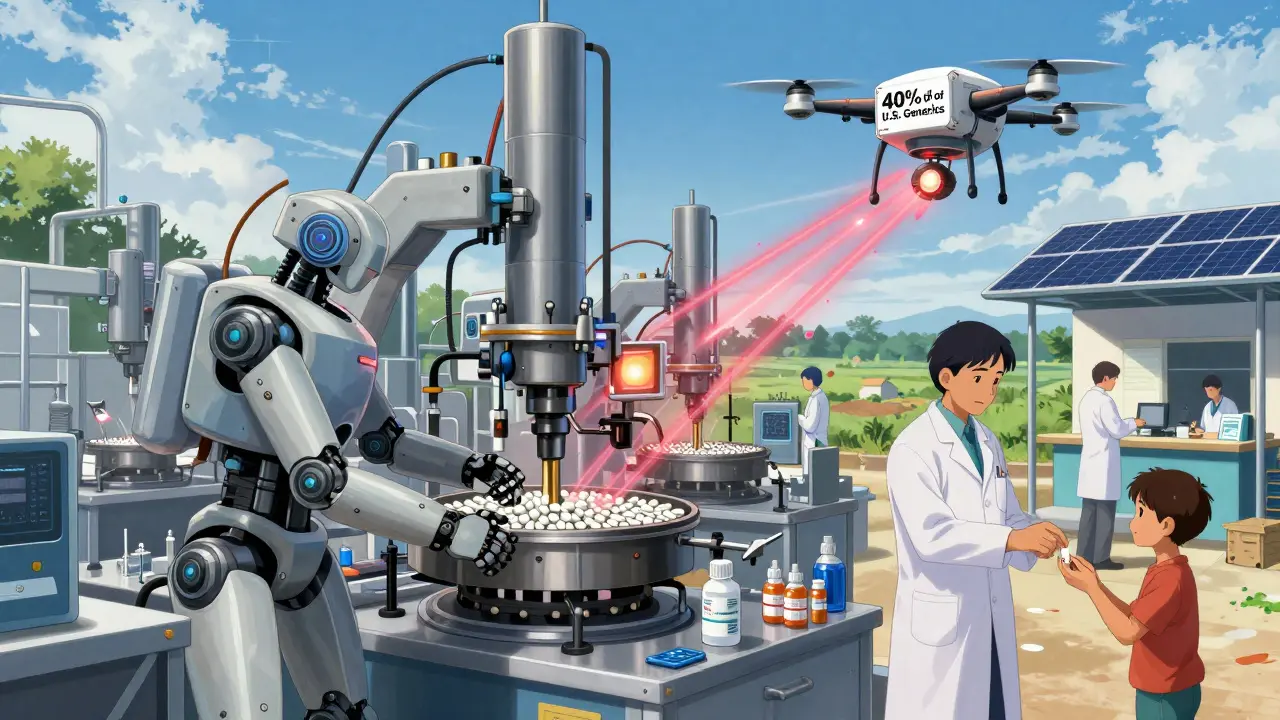
Japan: Price Cuts and Cultural Shifts
Japan has a unique approach. Every two years, the government forces drug prices down - including for generics. That means even brand-name drugs get cheaper over time, but generics drop faster. Doctors there have adapted. They don’t wait for patients to ask. They say: Here’s the generic. It’s cheaper, and it’s just as good. The result? Generic use in Japan has climbed steadily, even as overall drug spending stays flat. The government doesn’t just encourage generics - it makes them the easiest, cheapest option on the formulary. Doctors don’t see it as a compromise. They see it as smart medicine.Emerging Markets: Generics as the New Standard
In Brazil, Turkey, and parts of Africa, generics aren’t just popular - they’re the only option for most people. Healthcare systems are underfunded. Insurance is limited. Patients pay cash. Generics are the difference between treatment and no treatment. Doctors in these regions don’t have the luxury of waiting for brand-name drugs to come down in price. They prescribe generics because that’s what’s available - and because they’ve seen the outcomes. A diabetic patient in Lagos who gets a generic metformin pill lives longer than one who doesn’t get anything at all. The shift here is profound. Generics are no longer seen as a backup. They’re the first-line choice. And with rising chronic disease rates, that trend will only grow.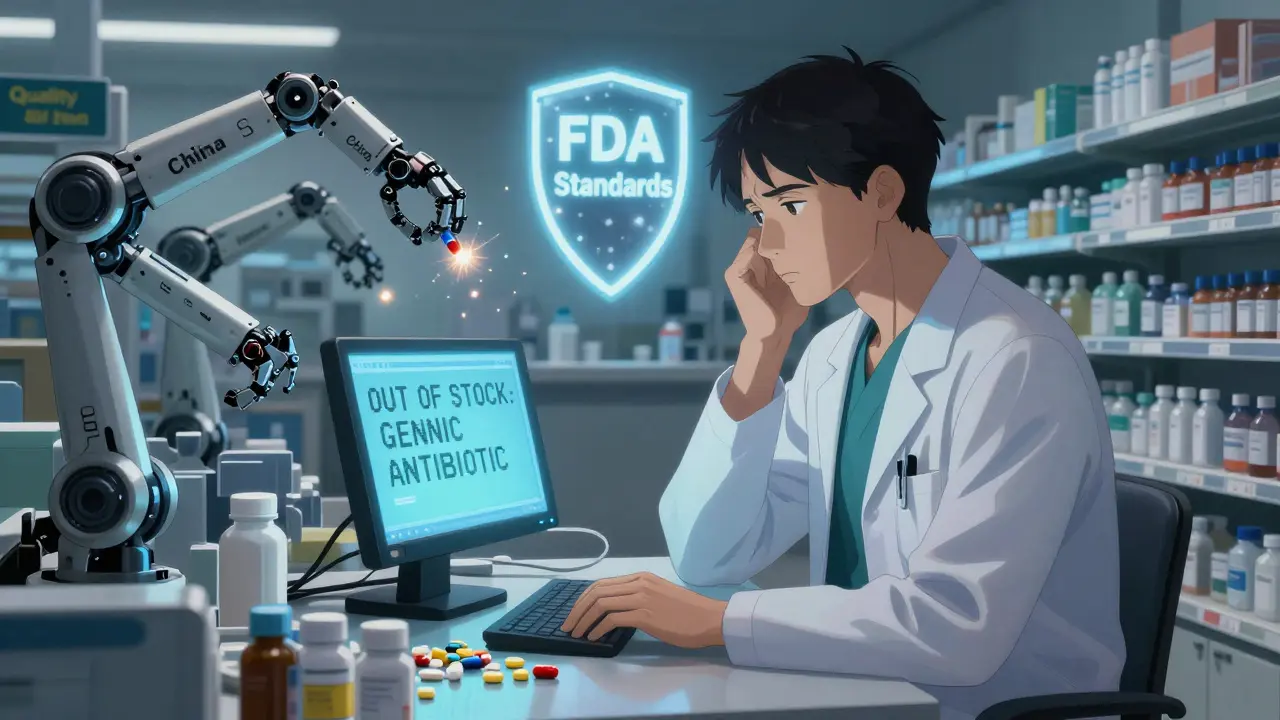
The Rise of Complex Generics
It’s not just pills anymore. Generics are moving into injectables, inhalers, and skin creams - the kind of drugs that used to be too complex to copy. In hospitals, doctors are now prescribing generic versions of chemotherapy drugs and insulin pens. These aren’t simple pills. They’re high-tech products. The market for these specialty generics is growing at over 11% a year. Why? Because patients need them, and they can’t afford the brand names. A generic version of an asthma inhaler might cost $50 instead of $300. That’s life-changing for families. Doctors in the U.S. and Europe are starting to see these as routine. In India, they’re already standard. The line between brand and generic is fading - especially when the science behind the drug is proven.What’s Driving the Change?
There’s one big reason all these countries are moving toward generics: patents are expiring. Between 2025 and 2030, over $200 billion worth of brand-name drugs will lose protection. That includes major treatments for cancer, autoimmune diseases, and heart failure. Companies like AbbVie and Roche are watching closely. This isn’t a small shift. It’s the biggest wave of generic competition in history. And providers everywhere are preparing for it. They know the prices will drop. They know the options will multiply. They just need to make sure the supply stays steady.What Providers Agree On
No matter where you are, doctors agree on three things:- Generics are safe when made under proper standards.
- They save patients money - sometimes dramatically.
- They’re essential for sustainable healthcare.
Are generic medications as effective as brand-name drugs?
Yes. By law, generic drugs must contain the same active ingredient, strength, dosage form, and route of administration as the brand-name version. They must also meet the same quality and performance standards set by regulators like the FDA or EMA. Thousands of studies confirm they work the same way in the body. The only differences are in inactive ingredients like fillers or dyes - which rarely affect how the drug works.
Why are generics so much cheaper?
Generics are cheaper because their manufacturers don’t have to repeat the expensive clinical trials that brand-name companies paid for. Once a patent expires, any qualified company can produce the drug. Competition drives prices down. In countries like India and China, lower labor and production costs make generics even more affordable. The savings aren’t from cutting corners - they’re from avoiding duplicate R&D costs.
Do doctors in the U.S. trust generics?
Most do - but with conditions. U.S. doctors trust generics when they’re reliable and consistently available. Problems arise when there are shortages or quality issues, which have happened with certain antibiotics and injectables. Trust isn’t about the drug itself - it’s about whether the supply chain can deliver it safely and on time. Many physicians now track which generic manufacturers they’ve seen work well over time.
Why does India supply so many U.S. generics?
India has a massive, well-established generic manufacturing industry with decades of experience producing high-volume, low-cost drugs. Its companies have passed U.S. FDA inspections at rates higher than many domestic producers. The country also benefits from lower labor costs, strong chemical engineering expertise, and government support for exports. About 40% of U.S. generic pills come from India because it’s the most reliable and cost-effective source globally.
Are there any generics that doctors avoid?
Yes - but not because generics are bad. Doctors sometimes avoid generics for complex formulations like inhalers, injectables, or topical creams, where small differences in delivery can affect how the drug works. These are called specialty generics, and not all versions are created equal. Until a generic has proven equivalence through real-world use, some providers stick with the brand. This is especially true in oncology and critical care.
Will generics become the only option in the future?
For most common drugs, yes. As more patents expire and healthcare costs keep rising, insurers and governments will push generics even harder. Brand-name drugs will still exist - especially for new, complex treatments like gene therapies - but for the vast majority of medications, generics will be the default. The question won’t be whether to use them, but which generic to choose and how to ensure consistent supply.


13 Comments
Bobby Collins
lol so the FDA is just a puppet for Big Pharma and India? 😂 I heard the generic pills from Hyderabad are filled with rat poison and chalk. My cousin took one for his blood pressure and woke up speaking Mandarin. 🤯
Olukayode Oguntulu
Ah, the neoliberal pharmacopeia-where commodification masquerades as accessibility. The very notion that ‘efficacy’ can be reduced to molecular equivalence is a metaphysical fallacy. The body is not a machine; it is a phenomenological field shaped by ontological context. Generics? A symptom of epistemic collapse. The patient becomes a data point in a global supply chain dystopia.
Meanwhile, in Lagos, a diabetic woman swallows a tablet forged in the crucible of late-stage capitalism and calls it ‘medicine.’ Tragic. Beautiful. Unavoidable.
LIZETH DE PACHECO
As someone who’s had to choose between insulin and groceries, I’m so grateful generics exist. No one should have to pick between health and rent. Seriously-thank you to every pharmacist who swaps the brand for the cheap one without asking. You’re saving lives.
Lee M
Let’s be real-America’s drug system is a rigged casino. Generics aren’t the problem. The problem is that the same factory in China that made your $0.10 pill also made the one that gave someone liver failure last year. And the FDA? They inspect one plant every 10 years. This isn’t healthcare-it’s Russian roulette with your meds.
Dusty Weeks
bruh why are we even talking abt this?? 🤡 generics are just branded drugs with a new label. they're the same. stop overthinking it. also i got my generic zzzquil and it made me dream i was a squirrel. 🐿️💤
Sally Denham-Vaughan
My grandma in rural Ohio takes five generics a day. She’s 82, walks two miles every morning, and still knits sweaters. No brand-name meds ever did that for her. The system’s broken, sure-but generics? They’re the glue holding people together. We need to fix the supply chain, not the pills.
Bill Medley
Regulatory integrity and manufacturing consistency are the foundational pillars of pharmaceutical safety. The efficacy of generic drugs is well-documented. The challenge lies in systemic oversight, not pharmacological equivalence.
Richard Thomas
It’s strange, isn’t it? We’ve spent decades convincing people that brand-name drugs are superior-marketing, ads, doctor visits all reinforcing that myth. And then, when you strip away the packaging, the logo, the price tag… the body doesn’t care. It responds to the molecule. The same molecule. The same chemistry. The same biology. The real tragedy isn’t that generics work-it’s that we had to be convinced they were even worth trying. We’ve been trained to fear the cheap. But cheap doesn’t mean bad. Sometimes, it just means someone else paid the upfront cost so you don’t have to.
Ann Romine
I lived in India for a year and was stunned by how casually doctors prescribed generics. No hesitation. No apology. Just: ‘Here, this will work.’ It made me realize how much fear and privilege shape our view of medicine in the U.S. We don’t distrust the drugs-we distrust the people who make them. And the system that lets them be made so far away.
Todd Nickel
One thing no one talks about: the psychological impact of generics. In the U.S., taking a generic feels like admitting you’re poor. Like you’re settling. Like you’re not worthy of the ‘real’ medicine. That stigma is manufactured. It’s not about efficacy-it’s about class. And it’s killing people who don’t take their meds because they’re too ashamed to pick up the $5 bottle instead of the $300 one. We need to change the narrative. Generics aren’t second-tier. They’re the backbone of public health.
Austin Mac-Anabraba
Let’s not pretend this is about patient care. This is about corporate consolidation. India and China are producing generics because they’ve been allowed to exploit labor, environmental regulations, and regulatory loopholes. The FDA’s approval process is a joke. And when a batch of contaminated valsartan hits the market, who pays? The patient. Who gets fined? A subsidiary in a shell corporation. The real villains aren’t the doctors-they’re the CEOs who profit from this global charade.
Phoebe McKenzie
HOW DARE YOU SUGGEST GENERICS ARE SAFE?!?!?! I SAW A VIDEO ON TIKTOK WHERE SOMEONE TOOK A GENERIC ANTIBIOTIC AND THEIR TONGUE MELTED OFF. 🤮 THIS ISN’T MEDICINE-IT’S A BIOLOGICAL TIME BOMB. WE NEED TO BAN ALL FOREIGN-MADE GENERICS. AMERICA FIRST. AMERICA HEALTHY. AMERICA NOT A PHARMACEUTICAL DUMPSTER FIRE.
Stephen Gikuma
So let me get this straight-we’re letting China and India make 40% of our medicine? And you’re okay with that? My grandpa fought in Korea to keep this country free. Now we’re letting foreign labs control our health. This isn’t capitalism. This is surrender. We need to bring manufacturing home. Even if it costs more. Even if it takes longer. Because some things are worth more than a buck.