

For decades, the PSA test has been the go-to tool for catching prostate cancer early. But here’s the truth: PSA screening isn’t a simple yes-or-no choice. It’s a minefield of trade-offs, and the biggest mistake men make is letting someone else decide for them. The test doesn’t tell you if you have cancer - it tells you your prostate is acting up. And that’s where things get messy.
What the PSA Test Really Measures
The PSA test checks blood levels of prostate-specific antigen, a protein made by the prostate gland. It sounds straightforward, but the numbers don’t mean what you think. A level above 4.0 ng/mL used to trigger alarms. Now, doctors know that’s outdated. Men in their 40s with a PSA of 2.5 ng/mL might need attention. Men in their 70s with 6.5 ng/mL could be perfectly fine. The test doesn’t care about age, health, or race - it just gives a number. And that number lies.
Here’s why: about 75% of men with PSA levels between 4.0 and 10.0 ng/mL don’t have cancer. Their results are false positives. Why? Benign enlargement, infection, even riding a bike or having sex the day before can spike PSA. At the same time, 15% of men with aggressive prostate cancer have PSA levels under 4.0. So you can be clean and still have cancer - or have a high number and be completely fine.
The Big Dilemma: Saving Lives vs. Causing Harm
Two massive studies gave us conflicting answers. The European study found that screening 1,000 men for 10 years saved 1 to 2 lives from prostate cancer. The American study? No benefit at all. So which one’s right? The truth is, both are. The difference comes down to who gets screened and how.
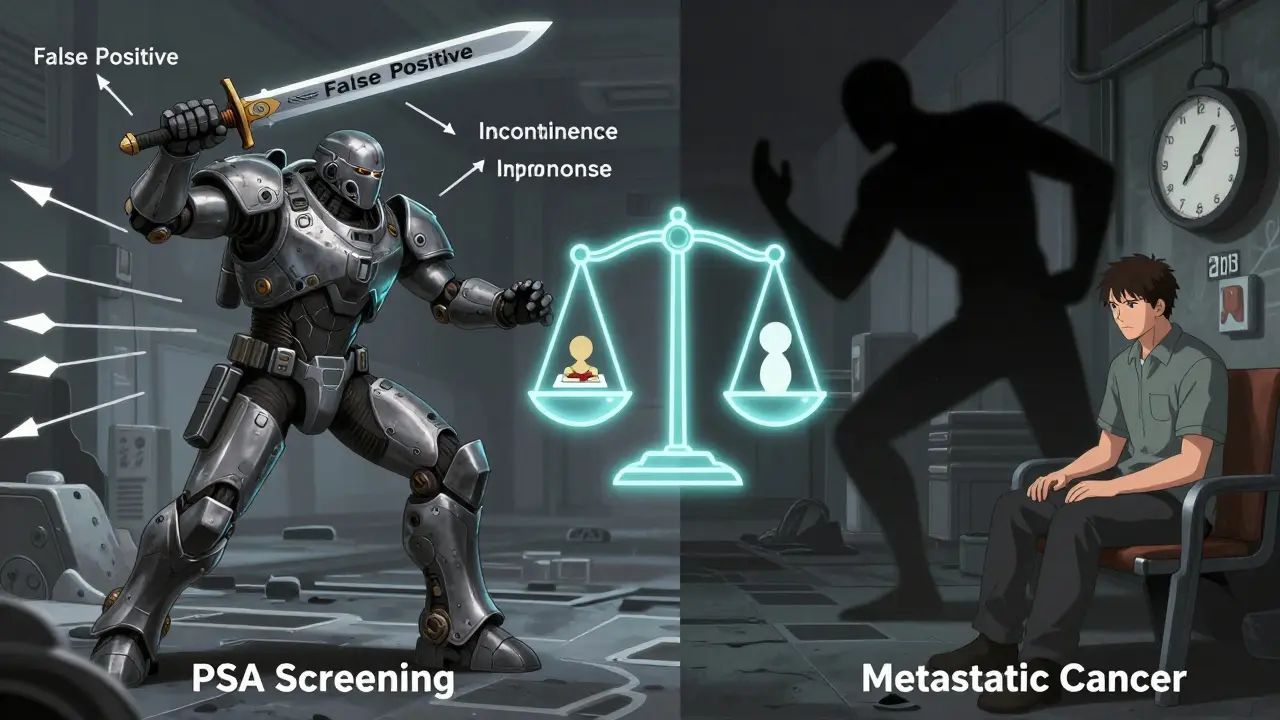
The real problem isn’t missing cancer - it’s finding cancer that never would’ve hurt you. Studies show 17% to 50% of prostate cancers detected by PSA are slow-growing, harmless tumors. Men get diagnosed, then panic. They choose surgery or radiation. And then they live with side effects: incontinence, impotence, chronic pain. One man in his 60s had a radical prostatectomy after a PSA of 4.7. His cancer was low-risk. He could’ve been monitored. Instead, he lost bladder control and sexual function for the rest of his life.
Meanwhile, men who skip screening entirely are at risk too. Between 2004 and 2013, metastatic prostate cancer - cancer that’s spread beyond the prostate - jumped 37%. That’s because fewer men were getting tested. Some of those men died because their cancer was caught too late.
What the Experts Say - And Why They Disagree
Doctors aren’t united. Some say PSA screening is outdated. Others say abandoning it is dangerous. Dr. Otis Brawley, former chief medical officer of the American Cancer Society, says screening leads to treating men who never needed treatment. Dr. Stacy Loeb, president of the Society of Urologic Oncology, warns that falling screening rates are putting men at risk. Both are right.
The U.S. Preventive Services Task Force flipped its stance twice. In 2012, they said don’t screen. In 2018, they said: for men 55 to 69, the benefit is small - but it exists. So the decision should be yours. That’s the new standard: shared decision-making. Not a recommendation. Not a routine. A conversation.
What Shared Decision-Making Actually Looks Like
This isn’t a 2-minute chat during a physical. It’s a 15- to 20-minute discussion. The doctor should explain:
- That PSA screening might save one life per 1,000 men screened over 10 years.
- That 100 to 120 of those men will get false positives, leading to biopsies.
- That 80 to 100 will be diagnosed with cancer they never needed to know about.
- That treatment carries serious risks - and not every cancer needs treatment.
Most men don’t get this. A 2022 study found primary care doctors spend an average of just 3.7 minutes on this topic. Only 38% of U.S. clinics have formal decision tools. Men who use decision aids - like visual charts showing risk numbers - are 35% less likely to feel conflicted afterward.
One tool from Mayo Clinic shows it this way: if 1,000 men get screened every year for 10 years, 240 will have unnecessary biopsies. One man will avoid dying from prostate cancer. That’s the trade-off. Not a guarantee. Not a cure. A gamble.
What’s Changing - And What’s Coming
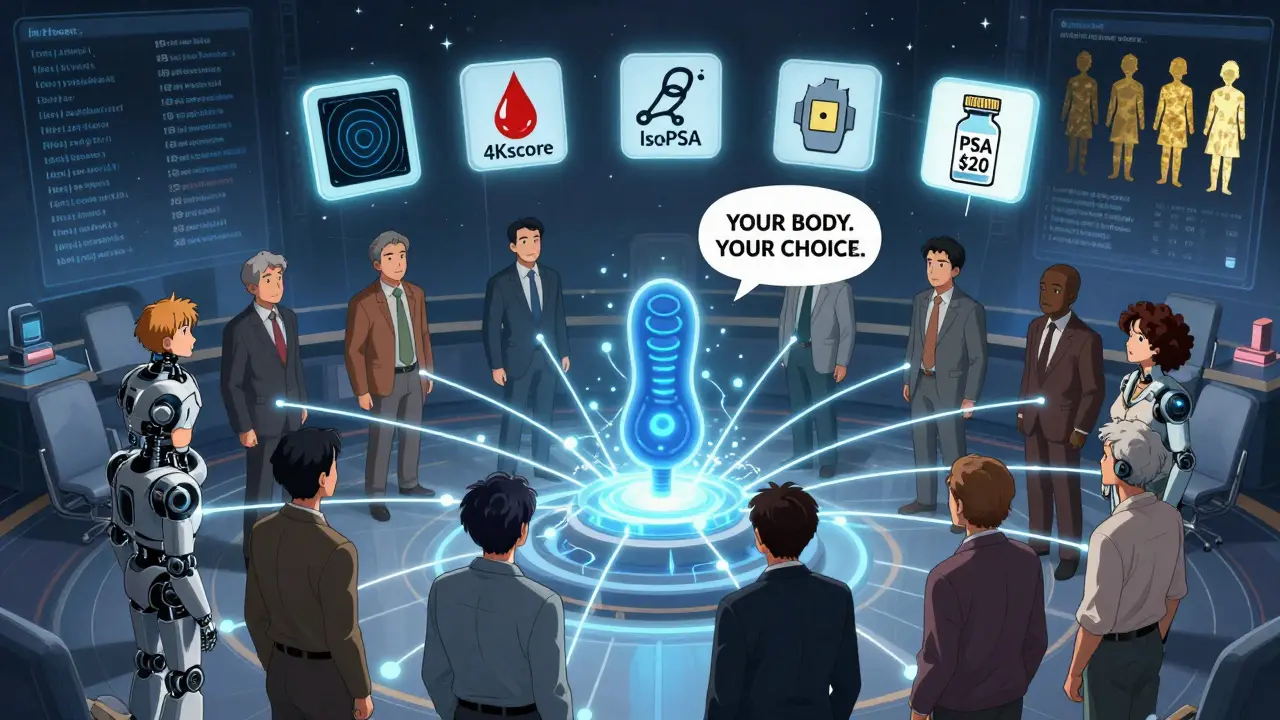
PSA isn’t going away. But it’s being joined by better tools. Multiparametric MRI can scan the prostate before a biopsy, cutting unnecessary procedures by 27%. The 4Kscore test, which looks at four proteins in the blood, can identify 95% of men at low risk for aggressive cancer. Genomic tests like Prolaris can tell if a diagnosed tumor is likely to spread - or stay harmless.
Even better, AI is stepping in. A 2023 MIT study showed an algorithm could predict prostate cancer risk from routine blood tests with 85% accuracy. That could cut unnecessary PSA tests by 30%. The FDA approved IsoPSA in 2021 - a next-gen PSA test that’s 92% specific for dangerous cancer, compared to 25% for the old version.
But here’s the catch: these tests cost $400 to $4,000. PSA? $20 to $50. Insurance doesn’t always cover the new ones. And until we have a cheap, accurate way to tell lethal cancer from harmless, PSA remains the only option most men have access to.
Who’s at Risk - And Who’s Left Behind
African American men are 70% more likely to get prostate cancer and more than twice as likely to die from it. Yet they’re 23% less likely to have a shared decision-making talk before screening. Why? Systemic gaps in care. Language barriers. Lack of trust. Time. These aren’t just medical issues - they’re equity issues.
Men with a family history of prostate cancer, or those with BRCA gene mutations, have higher risk. But they’re rarely offered personalized screening plans. Baseline PSA at age 45 might be the key. Men with a baseline under 1.0 ng/mL have such low risk they may not need another test until 55. But most doctors don’t check it.
What You Should Do - Right Now
If you’re a man between 50 and 69:
- Don’t wait for your doctor to bring it up. Ask: “Should I get a PSA test?”
- Ask: “What are the chances this test will save my life? What are the chances it will cause more harm?”
- Ask: “What happens if I say no? What happens if I say yes?”
- Ask: “Do I have any risk factors - race, family history, genetics?”
- Ask: “Can I get a copy of the decision aid you use?”
If you’re under 50 or over 70, the answer is usually no - unless you have high-risk factors. But even then, don’t assume. Talk.
If you’ve had a high PSA and are facing a biopsy or treatment, ask: “Is this cancer aggressive? Can I wait and monitor it?” Active surveillance is now the standard for low-risk cases. It’s not giving up. It’s being smart.
Why This Isn’t About Fear - It’s About Control
Men don’t fear cancer. They fear losing control. Over their bodies. Over their futures. Over their quality of life. PSA screening isn’t a health check. It’s a life-altering decision wrapped in a blood test. And if you don’t understand the trade-offs, you’re not making a choice - you’re letting someone else decide for you.
The goal isn’t to stop screening. It’s to make sure every man who gets screened knows what he’s signing up for. Not because it’s risky. But because it’s complicated. And you deserve to understand that.
Is PSA screening still recommended?
Yes - but only for men aged 55 to 69 after a shared decision-making conversation. The U.S. Preventive Services Task Force gives it a Grade C recommendation, meaning the benefit is small but exists. For men under 55 or over 70, screening is generally not recommended unless there are high-risk factors like family history or African American heritage.
Can I avoid a biopsy if my PSA is high?
Yes. Multiparametric MRI (mpMRI) is now used before biopsy in many clinics. If the MRI looks normal, a biopsy may be avoided. Studies show this cuts unnecessary biopsies by 27% without missing dangerous cancers. Some doctors also use advanced blood tests like the 4Kscore or PHI to better assess risk before jumping to biopsy.
What if I have a high PSA but no cancer?
It’s common. About 75% of men with PSA levels between 4.0 and 10.0 ng/mL don’t have cancer. Causes include benign prostate enlargement (affects half of men by 60, 90% by 85), infection, recent ejaculation, or even vigorous exercise. Your doctor should repeat the test, check for infection, and consider other factors like PSA density or velocity before recommending a biopsy.
Does PSA screening save lives?
It can - but rarely. In large studies, screening 1,000 men over 10 years prevents 1 to 2 deaths from prostate cancer. But for every life saved, about 100 men get false positives, and 80 to 100 are overdiagnosed with cancers that would never have caused harm. The trade-off is real: small benefit, significant risk of harm.
Why do some doctors still push PSA screening?
Some doctors still believe early detection saves lives and fear missing aggressive cancers. Others may not be fully trained in shared decision-making or may be influenced by outdated guidelines. A 2023 survey found only 29% of primary care physicians feel confident discussing PSA screening trade-offs. Many men report being told only the benefits - never the risks.
What’s the best alternative to PSA screening?
There’s no perfect alternative yet. But combining PSA with other tools improves accuracy. For men at average risk, starting with a baseline PSA at age 45-50 can guide future screening. For those with elevated PSA, an mpMRI before biopsy reduces unnecessary procedures. Advanced blood tests like 4Kscore or IsoPSA offer better specificity. But none are widely used or covered by insurance yet. For now, PSA remains the most accessible tool - if used wisely.



15 Comments
Sanjana Rajan
Ugh, I can't believe men still let doctors push this test like it's a vaccine. PSA is a scam. My uncle got diagnosed with 'low-risk' cancer after a 5.1 reading, had surgery, and now he's incontinent at 62. They didn't even mention active surveillance. It's not medicine-it's profit-driven panic.
And don't even get me started on the 'shared decision-making' buzzwords. Most docs don't even finish their coffee before saying, 'You should get it.' No, I should get *information*.
Kyle Young
The philosophical tension here is fascinating. We treat a biomarker like a moral verdict-high PSA equals impending doom, low equals innocence. But biology doesn't operate on binary logic. The real issue isn't the test; it's our cultural inability to tolerate uncertainty. We demand certainty where none exists, then punish ourselves for the ambiguity we forced upon the system.
Perhaps the most courageous act isn't screening or not screening-it's accepting that some truths are probabilistic, not categorical.
Aileen Nasywa Shabira
Oh wow, another 'let's have a conversation' article. Like men haven't been gaslit by medicine for decades. PSA? More like PSA-Please Screen Again.
Meanwhile, the same system that tells you to 'get screened' also denies you coverage for mpMRI unless you're rich. And if you're Black? Good luck getting a doctor to even say 'risk factors' out loud. This isn't shared decision-making. It's performative allyship with a lab slip attached.
Kendrick Heyward
I'm so tired of men being told to 'talk to their doctor' like it's a dating app. My dad got a PSA test at 58 and was immediately pushed into a biopsy. He cried in the waiting room because he thought he was dying. Then they found nothing.
Why do we make men feel guilty for not being 'proactive'? I'm not proactive-I'm traumatized. And I'm not alone. 😔
lawanna major
There is profound wisdom in the concept of shared decision-making-not because it's trendy, but because it restores agency. Medicine has long operated under the assumption that patients are passive recipients of expert knowledge. But when a man understands that one life may be saved among a thousand screened, and that eighty to one hundred of those men will endure unnecessary trauma, he is no longer a patient-he is a participant.
This is not about fear. It is about dignity. And dignity, in healthcare, is not a luxury. It is the baseline.
Ryan Voeltner
The evidence suggests that the value of PSA screening is narrow and context dependent. For men aged 55 to 69 with average risk, the benefit is statistically real but clinically modest. For those with elevated risk factors, the calculus shifts. The challenge lies not in the data but in its translation.
Healthcare systems must prioritize structured dialogue over protocol. Time, training, and tools are the missing triad. Without them, even the best guidelines become empty words.
Linda Olsson
Let me guess-this is sponsored by Big Pharma. PSA tests are just the gateway drug. Once you're hooked on 'early detection,' they sell you the MRI, then the 4Kscore, then the genomic panel, then the surgery.
And guess who pays? You. Your insurance. Your taxes. Meanwhile, the real killer? Poor diet, sedentary lifestyle, and stress. But you can't sell a supplement for that. So they sell you a blood test. Classic.
Ayan Khan
In India, we rarely talk about prostate health until it's too late. Men are taught to be silent about pain, to endure, to not complain. But this isn't strength. It's silence bred from fear.
The idea of shared decision-making feels foreign here, but it’s also revolutionary. Maybe the first step isn't the test-it's the conversation. Between husband and wife. Between son and father. Between doctor and patient. We need to start talking before the numbers matter.
Emily Hager
I find it deeply troubling that the article frames this as a 'choice' when systemic inequities dictate who even gets to make that choice.
Black men are 23% less likely to have a shared decision-making conversation. Yet the piece doesn't address why. Is it bias? Lack of providers? Insurance denial? Or is it simply that the system was never designed for them to survive?
It's not about PSA. It's about who gets to be seen.
Lauren Volpi
PSA is a joke. My cousin got a 12.3 reading. They did a biopsy. Turned out he had a UTI from holding it too long. No one told him to wait, hydrate, avoid biking. Just: 'Here's your appointment.'
And now he's got PTSD from needles. Meanwhile, the guy who actually had aggressive cancer? He skipped screening because he 'didn't trust doctors.' He died last year.
So yeah. Everyone loses. Except the labs.
Kal Lambert
PSA isn't perfect. But it's the only tool most men have.
Use it. But don't panic. Talk to your doc. Ask about MRI. Ask about monitoring. Ask if your numbers make sense for your age and race.
That's it. No drama. Just smart questions.
Melissa Stansbury
I'm a nurse. I've seen this too many times. A man comes in, gets a high PSA, and I watch him spiral. He Google's 'prostate cancer survival rates.' He texts his brother. He cancels his vacation. He starts crying in the parking lot.
And then we do the biopsy. And it's benign.
Why are we letting a number break men before we even know if it's real?
Robin Hall
The FDA approval of IsoPSA in 2021 was a watershed moment. Yet, the article fails to mention that this test is not yet integrated into Medicare or Medicaid guidelines. This is not a medical innovation gap-it is a policy failure.
When a test is 92% specific and costs $400, yet remains inaccessible to 70% of the population, we are not practicing medicine. We are practicing classism disguised as science.
jared baker
PSA is like a smoke alarm. Sometimes it goes off for toast. Sometimes it doesn't go off when there's fire.
Don't ignore it. Don't panic. Ask questions. Get the MRI if it's high. Wait if it's low. Talk to your doc. That's all.
Michelle Jackson
i mean like... why are we even talking about this? my bro got his psa done and it was fine. he didn't even think about it. now he's fine. why do we need all these charts and tests? just go get it done and chill.
also why is everyone so obsessed with 'risk' like we're all gonna die tomorrow? life is short. live it.