
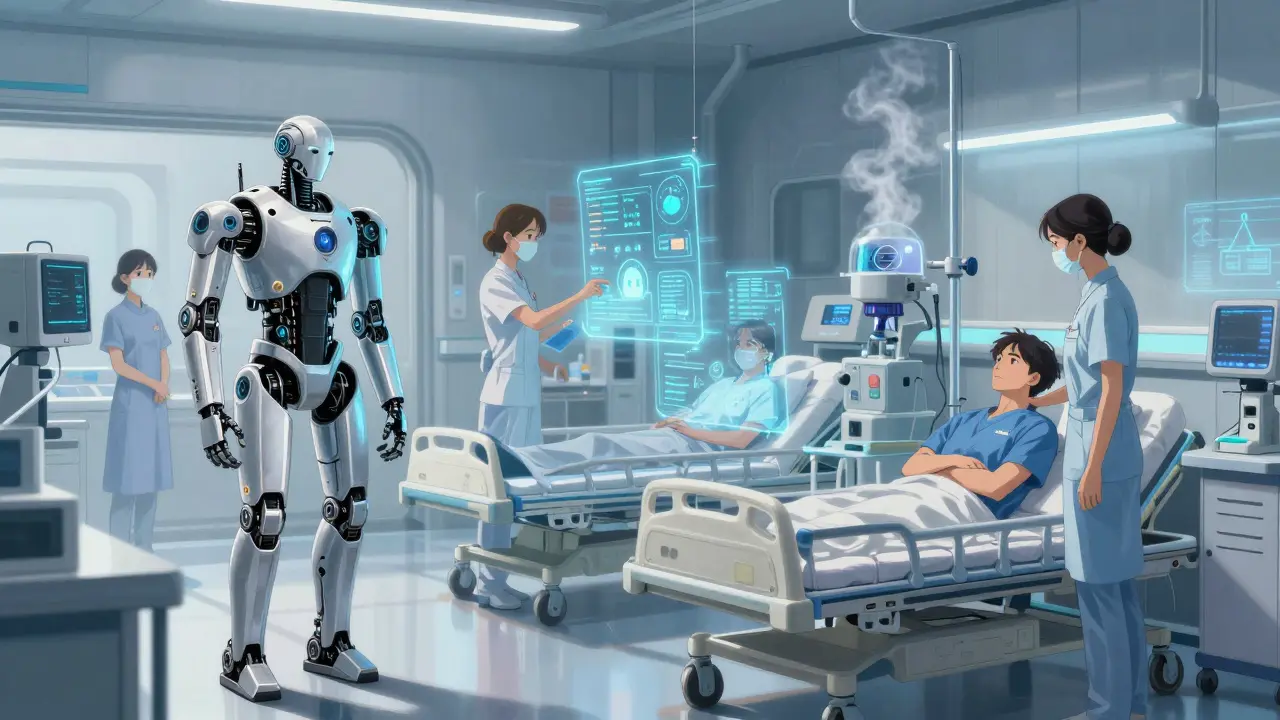
Health systems are running out of staff - and they’re not waiting for federal fixes
It’s 2026, and hospitals across the U.S. are still scrambling to fill open nursing positions. Emergency rooms delay care. Surgeons cancel elective procedures. Pharmacists double-check prescriptions because there’s no one left to verify them. The problem isn’t just drugs - it’s people. The U.S. Health Resources & Services Administration predicts a shortfall of 3.2 million healthcare workers by the end of this year. That’s not a forecast. It’s a countdown.
Some systems are still hiring travel nurses at $8,000 a week. Others are turning to AI to handle paperwork so nurses can focus on patients. A few are even partnering with local community colleges to train new staff before they graduate. What works? It’s not one fix. It’s a mix of quick fixes and long-term bets.
Immediate fixes: filling gaps with temporary help
When a unit is short-staffed, the first move is often to bring in outside help. Travel nurses, per diem staff, and international hires are no longer exceptions - they’re standard. In 2024, 22% of U.S. hospitals relied on per diem workers to cover shifts. Another 18% hired internationally, mostly from the Philippines, India, and Canada. These aren’t stopgaps anymore. They’re part of the operating model.
But temporary staff come at a cost. Travel nurse contracts can cost three times more than regular salaries. Some hospitals are cutting back. Instead, they’re using virtual nursing. Telehealth nurses now monitor up to 20 patients remotely at once, handling routine check-ins, medication reminders, and even basic triage. Between 2022 and 2024, adoption jumped from 35% to 68% of health systems. That’s not just convenience - it’s a force multiplier.
Keeping staff from quitting: retention is cheaper than hiring
Hiring a new nurse costs an average of $50,000. Retaining one? A fraction of that. The most successful systems are focusing on what keeps people from walking out: burnout.
Flexible scheduling is making a real difference. At hospitals running pilot programs, offering choice in shift times - like 3x12-hour shifts instead of 5x8s - cut burnout by 19%. Some even let nurses pick their own schedules weeks in advance. At Cleveland Clinic, this alone reduced turnover by 25%.
Mental health support is no longer optional. Hospitals are now embedding counselors in units, offering free therapy sessions, and training managers to spot signs of emotional exhaustion. One study found that teams with access to mental health resources saw turnover drop by 17%. That’s not a perk - it’s a survival tactic.
And then there’s career growth. Nurses who see a clear path forward - like moving from floor nurse to case manager, or from RN to nurse practitioner - are 23% more likely to stay. Programs that offer tuition reimbursement, certification support, and internal promotions are becoming common. At Kaiser Permanente, nurses who entered accelerated NP programs were 40% less likely to leave within two years.
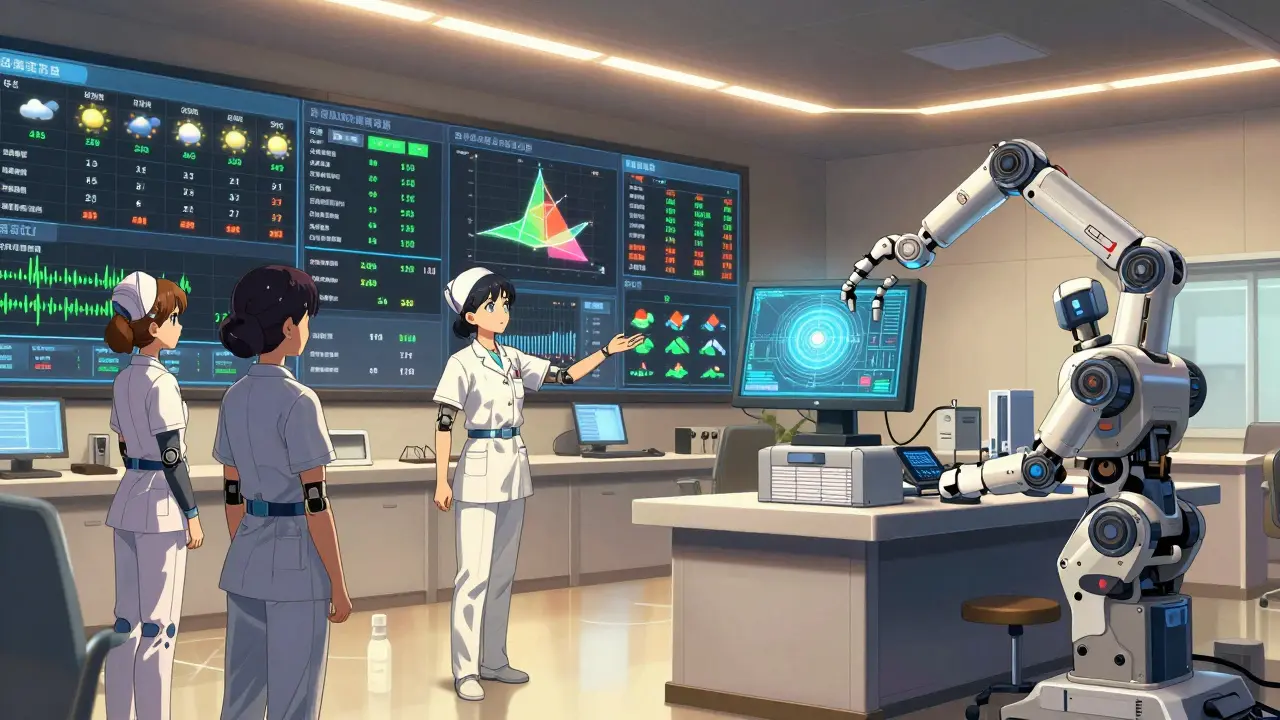
Technology isn’t replacing people - it’s unburdening them
AI isn’t here to take jobs. It’s here to take the junk off the plate.
Baptist Health cut administrative work by 37% using AI-powered document processing. That means nurses aren’t spending hours filling out forms or chasing down signatures. Instead, they’re with patients. Blue Cross Blue Shield of New Mexico invested $500,000 in 2024 to build tools that automate prior authorizations - a task that used to take days. Now it’s done in minutes.
Robotic Process Automation (RPA) is handling billing, scheduling, and insurance verifications. IDC predicts healthcare will save $382 billion by 2027 through these tools. That money doesn’t go to shareholders - it goes back into hiring more staff, raising wages, or improving training.
Some hospitals are even using AI to predict staffing needs. By analyzing patient admission trends, flu outbreaks, and even weather patterns, systems can now forecast which units will be overwhelmed next week - and adjust schedules before the crisis hits.
Building the next generation: training faster, smarter
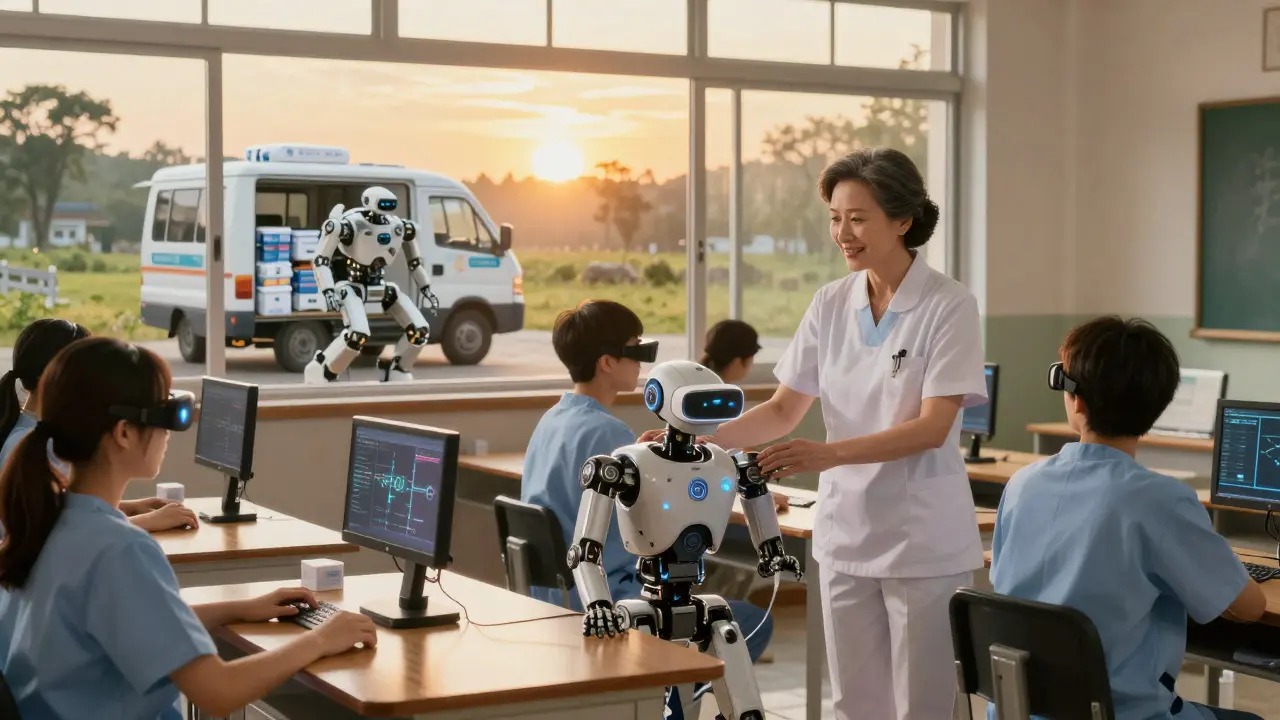
Training a nurse used to take four years. Now, accelerated programs are cutting that to two. Between 2013 and 2023, these programs nearly doubled graduation numbers, adding 8,000 new nurses annually. Community colleges are partnering with hospitals to create “earn-and-learn” tracks - students get paid while they train, and hospitals guarantee jobs upon completion.
Mayo Clinic’s partnership with Minnesota community colleges boosted their local pipeline by 47% between 2022 and 2024. That’s not just filling roles - it’s rebuilding trust in rural areas where people used to leave for city hospitals.
Micro-credentials are also changing how skills are recognized. A nurse can now earn a badge in wound care, diabetes management, or palliative care in just a few weeks. These aren’t just certificates - they’re proof of competence that leads to higher pay and more responsibility. Systems using this approach saw job satisfaction rise by 18%.
Expanding roles: letting nurses and PAs do more
Doctors can’t be everywhere. But nurse practitioners and physician assistants can.
In 2025, 78% of primary care clinics now use team-based models where NPs and PAs handle up to 60% of patient visits - from chronic disease checks to minor injuries. This doesn’t replace doctors. It frees them up for complex cases. A March 2025 study in Health Affairs found these teams increased patient capacity by 33% without lowering quality.
Some states have passed laws letting PAs prescribe controlled substances without physician oversight. Others are allowing nurses to perform basic procedures in urgent care centers. These aren’t cuts - they’re expansions. They let the right person handle the right task.
Long-term bets: policy, pay, and partnerships
Money talks. Sign-on bonuses averaging $15,000-$25,000 are now standard. Tuition reimbursement is offered by 68% of major health systems. Public hospitals use loan forgiveness programs - 57% offer them - to attract staff to underserved areas.
But money alone won’t fix this. That’s why systems are pushing for policy changes. Kaiser Permanente is lobbying to increase residency slots by 14,000 under the Resident Physician Shortage Reduction Act. The National Governors Association has helped 34 states build coordinated talent pipelines - connecting employers, schools, and state agencies.
Intermountain Healthcare reduced vacancy rates from 18% to 7% between 2022 and 2024 by combining flexible scheduling, AI tools, and community college partnerships. That’s not luck. It’s strategy.
The gap is still wide - but progress is real
Despite all this, 63% of healthcare workers still report burnout. 42% of nurses say they’re thinking of leaving. The problem isn’t solved. But the direction is clear.
The most successful health systems aren’t choosing between tech and people. They’re using tech to give people back time. They’re not just hiring - they’re growing talent locally. They’re not waiting for Congress - they’re building solutions now.
It’s not about doing more with less. It’s about doing less with more - less paperwork, less stress, less wasted energy - so people can do what they signed up for: care for patients.
What’s next? The next wave of innovation
By 2027, 89% of healthcare leaders plan to increase spending on AI and automation. That means smarter scheduling tools, predictive staffing models, and voice-activated documentation that lets nurses talk instead of type.
Phased retirement programs are gaining traction. Older clinicians who want to slow down can keep teaching, mentoring, and seeing patients part-time - with full benefits. At Johns Hopkins, this kept clinical faculty in the system longer, increasing retention by 22%.
Home-based care is expanding, too. Instead of sending elderly patients back to the hospital after surgery, teams now visit them at home. CMS data shows this cut readmissions by 22% - and gave patients dignity.
The future isn’t about replacing humans. It’s about protecting them - so they can keep doing the work that machines can’t.
Why are healthcare staffing shortages getting worse?
The shortage is worsening because of three big trends: an aging population needs more care, older healthcare workers are retiring faster than new ones can replace them, and burnout is driving people out of the field. The U.S. alone will need over 3 million more workers by 2026. Global projections from the WHO show a shortfall of 11 million by 2030 - especially in low-income countries.
Are travel nurses still a big part of the solution?
Yes, but less than before. In 2023, 12.7% of U.S. hospitals used travel nurses during peak times. Today, many are shifting toward building internal staffing pools and using virtual nursing to reduce reliance on expensive contracts. Travel nurses still fill critical gaps, but they’re no longer the primary strategy - just one tool among many.
How is AI helping with staffing shortages?
AI handles administrative tasks that eat up staff time - like filling out forms, processing insurance claims, and managing schedules. Baptist Health cut paperwork by 37% using AI document processing. Other systems use AI to predict patient volume and adjust staffing ahead of time. This doesn’t replace nurses - it gives them back hours each week to focus on patients.
What’s the most effective way to retain nurses?
The most effective strategies combine flexibility, career growth, and mental health support. Nurses who can choose their shifts, access free counseling, and see a clear path to promotion (like becoming a nurse practitioner) are far more likely to stay. Cleveland Clinic saw turnover drop by 25% just by giving nurses control over their schedules.
Can community colleges really help solve the shortage?
Absolutely. Hospitals partnering with local community colleges are seeing faster, cheaper, and more reliable hiring. Mayo Clinic’s program in Minnesota increased their local healthcare worker pipeline by 47% in two years. Students get paid while they train, and hospitals guarantee jobs. It’s a win-win that builds trust in communities that need care the most.
Why aren’t more hospitals using nurse practitioners and PAs?
They are - and fast. In fact, 78% of primary care clinics now use team-based models with NPs and PAs. The barrier isn’t willingness - it’s outdated regulations in some states that limit what these providers can do. As laws change, their role will keep expanding, helping reduce doctor overload and improve access.
Is the healthcare workforce crisis worse in rural areas?
Yes. Rural hospitals are hit hardest - 83% of facilities in low-income countries lack basic workforce planning tools, and in the U.S., rural areas struggle to attract and keep staff. Programs like Mayo Clinic’s community college partnerships are proving that local training and incentives can reverse the trend. But without targeted investment, the gap will keep growing.


13 Comments
Naresh L
It's fascinating how we're treating healthcare like a supply chain problem instead of a human one. We automate paperwork, hire travel nurses, and throw AI at symptoms-but what if the core issue is that we've forgotten why people became caregivers in the first place? The soul of nursing isn't in scheduling algorithms or micro-credentials. It's in the quiet moments: holding a hand, listening without rushing, being present when no one else is. No algorithm can replicate that. And until we rebuild that meaning into the job, we're just rearranging deck chairs on the Titanic.
Lilliana Lowe
Actually, the article is riddled with misleading statistics. The HRSA projection of 3.2 million shortages is extrapolated from outdated labor models that don’t account for telehealth efficiency gains or the fact that many RNs are transitioning to non-clinical roles-not leaving the field entirely. Also, ‘AI-powered document processing’ is a buzzword-laden euphemism for outsourcing data entry to offshore contractors under the guise of innovation. And don’t get me started on the ‘earn-and-learn’ programs-they’re just glorified indentured servitude with a wellness pamphlet.
vivian papadatu
I love how this piece avoids the real elephant in the room: we’ve turned healthcare into a corporate profit engine and then act shocked when people burn out. 🤔
But seriously-kudos to the systems actually trying. Flexible scheduling? Mental health support? Local training pipelines? These aren’t ‘innovations.’ They’re basic human decency. The fact that we have to call them ‘strategies’ says everything about how broken the system is. If we treated teachers or firefighters this way, we’d be in riots. Yet here we are, applauding hospitals for not actively driving nurses away.
Deep Rank
ok but like... let me be real here, all this talk about AI and microcredentials and nurse practitioners? it's just a distraction from the fact that nurses are being treated like disposable widgets and no one wants to admit it. i worked in a hospital for 3 years and saw nurses cry in the supply closet because they had 7 patients and 2 aides and no lunch break for 12 hours. and then the admin got a 15% bonus. so yeah, sure, let's automate the paperwork so you can still make nurses do 12 hour shifts with no support. it's not a shortage of people, it's a shortage of conscience. and also, why do all these 'success stories' always come from big fancy hospitals? what about the ones in rural towns where the only 'solution' is a locum tenens who leaves after 2 weeks? 🙄
Naomi Walsh
Let’s be honest-this entire article reads like a PR brochure for healthcare conglomerates. ‘AI unburdens nurses’? No. It just makes them responsible for twice as many patients while the tech team gets a raise. And ‘community college partnerships’? That’s just shifting the cost of training onto taxpayers while hospitals pocket the savings. The only thing that works is raising wages to match inflation and capping shift lengths. Everything else is theater. If you want to retain staff, pay them like they’re saving lives-not like they’re gig workers.
Aditya Gupta
Biggest win? Letting nurses pick their own shifts. That’s it. No AI, no fancy degrees. Just respect. I’ve seen it in my cousin’s hospital-turnover dropped, morale shot up. Simple stuff works. Why’s that so hard to believe?
June Richards
AI is just making nurses into data entry clerks with stethoscopes. 😒
Lu Gao
Actually, the most effective strategy isn’t mentioned here: mandatory staffing ratios. California’s had them since 2004. Nurse burnout? Lower. Patient outcomes? Better. Hospitals complained it’d bankrupt them. Guess what? They didn’t. But no one talks about it because it requires regulation, not ‘innovation.’
Jamie Allan Brown
There’s something quietly beautiful in how some systems are choosing to rebuild trust-not just staffing. The Mayo Clinic partnerships with community colleges? That’s not just hiring. That’s investing in a community’s future. When a kid from a rural town sees someone who looks like them, speaks like them, went to their school, become a nurse-it changes everything. It says: you belong here. You’re needed. And that kind of belonging? No algorithm can replicate it.
Lisa Rodriguez
Just saw a nurse yesterday who said her favorite part of the job now is that she gets to breathe between patients because the AI handled her charting. That’s not a win for tech-that’s a win for humanity. We’re not replacing people. We’re giving them back their dignity. And yes, I cried reading that part. 😔
Ed Di Cristofaro
Y’all are acting like this is some new problem. Nah. Nurses have been getting screwed since the 80s. The only thing that changed? Now they’re getting screwed with AI and fancy PowerPoint slides. Pay them more. End of story.
Melissa Melville
So we’re gonna train nurses in 2 years, let them do everything doctors do, and call it progress? Cool. Next we’ll let baristas do brain surgery. 🤷♀️
Bryan Coleman
My sister’s a nurse in Ohio. She got a $20k sign-on bonus last year. She quit 6 months later. Said the bonus felt like a bribe to stay until they found someone cheaper. This isn’t a fix. It’s a bandaid on a hemorrhage.