

Most people think being a morning person or a night person is just a matter of preference. But it’s not. Your chronotype is written into your genes, shaped by light, and locked in by your daily habits. If you’ve ever dragged yourself out of bed at 6 a.m. only to feel like a zombie until noon, or if you’re wide awake at 2 a.m. while everyone else is asleep, you’re not lazy-you’re just mismatched with the clock society forces you to follow.
What Exactly Is a Chronotype?
Your chronotype is your body’s natural rhythm for when you feel alert and when you feel sleepy. It’s not about how much sleep you get-it’s about when you get it. Scientists divide people into three main groups: morning larks (early risers), night owls (late sleepers), and intermediates (the majority). About 40% of people are larks, 30% are owls, and the rest fall somewhere in between.
This isn’t personality. It’s biology. Your internal clock, called the circadian rhythm, controls when your body releases melatonin, cortisol, and other hormones that tell you when to wake up, when to focus, and when to wind down. The Munich ChronoType Questionnaire (MCTQ), developed by Till Roenneberg, measures this by tracking your sleep midpoint on free days-when you don’t have to set an alarm. For most people, that’s between 11:30 p.m. and 8 a.m. But for extreme larks, it’s 4 a.m. Wake-up time. For extreme owls, it’s 8 a.m. Sleep time.
Why Morning Larks and Night Owls Are So Different
It’s not just about sleep timing. The differences run deeper. According to SleepWatch’s analysis of over 10,000 users, morning larks get nearly 48 more minutes of sleep per night than night owls. They also have 7 percentage points more consistency in their sleep schedule. And they’re 40% more likely to wake up feeling rested.
But here’s the twist: larks aren’t necessarily smarter or more productive. In fact, a 2023 study from Imperial College London found that among older adults, night owls performed better on cognitive tests than morning types. That flips the old assumption that early risers are the high achievers. The truth? Chronotype affects performance differently depending on your age.
For younger people, morning types often score higher in school because classes start early. But for older adults, the evening rhythm seems to preserve mental sharpness longer. Still, owls pay a price. They’re 27% more likely to be obese, 30% more likely to develop type 2 diabetes, and 29% more likely to suffer from depression. A 2018 study of 430,000 people showed evening chronotypes had a higher risk of early death.
The Hidden Cost of Being an Owl in a Lark World
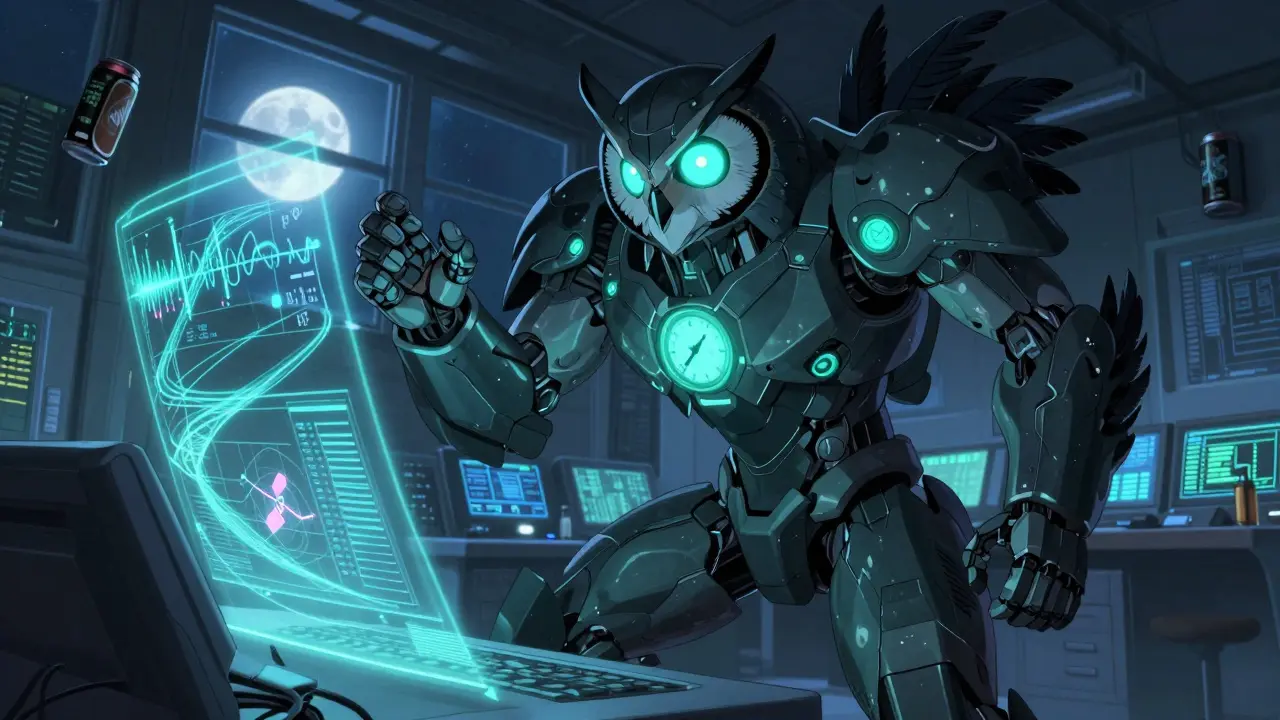
Imagine being forced to wake up at 6 a.m. every day when your body doesn’t want to be awake until 10 a.m. That’s social jet lag-the gap between your biological clock and your social schedule. It’s not just annoying. It’s harmful.
Baylor University’s research on college students found that evening-type students who had to attend 8 a.m. classes slept an average of 6.2 hours per night, compared to 7.5 hours for morning types. They were more tired in class, used social media in bed for 40 minutes longer, and drank caffeine 2.7 hours later in the day. Their GPAs were lower. Their stress was higher. And they weren’t even trying to be lazy.
One Reddit user, u/NightOwlStruggles, summed it up: “As a software developer forced into 8 a.m. standups, I lose 3 productive hours daily fighting sleepiness.” That’s not poor time management. That’s a system designed for the wrong kind of person.
Can You Change Your Chronotype?
For years, scientists thought chronotype was fixed. Then came the camping study.
In 2013, Dr. Kenneth Wright took a group of people into the Colorado wilderness for a week-with no electric light, no screens, just sunrise and sunset. By the end, the differences between larks and owls vanished. Their bodies synced to natural light. The takeaway? Your chronotype isn’t set in stone. It’s shaped by your environment.
Since then, research from Baylor University shows chronotypes can shift-even over a single semester. About 28% of students changed their rhythm through small, consistent changes: getting morning sunlight, cutting caffeine after 5 p.m., and keeping a fixed wake-up time-even on weekends.
You can’t turn an owl into a lark overnight. But you can nudge your rhythm. The key is light. Exposure to bright light (at least 10,000 lux) within 30 minutes of waking helps reset your clock. Darkness at night is just as important. No phone screens. No TV. Keep your bedroom at 0-5 lux. That’s the level of a dim nightlight.
How to Schedule Your Life Around Your Chronotype
If you’re a lark, you’re already ahead. Use your early energy for deep work, exercise, and planning. Save low-focus tasks like emails for the afternoon.
If you’re an owl, don’t fight it. Fight the schedule instead.
- Ask for a later start time. Many remote jobs now allow flexible hours.
- Negotiate virtual meetings for after 10 a.m. If you’re in a hybrid role, push for core hours that match your rhythm.
- Block your most creative hours for high-value work-usually between 2 p.m. and 10 p.m. for owls.
- Use caffeine strategically. Don’t drink it after 5 p.m. unless you want to be wide awake at 2 a.m.
- Stop scrolling in bed. The blue light delays melatonin by up to 90 minutes.
One student in Baylor’s study shifted from evening to morning type over three months. Her GPA jumped 0.45 points. She didn’t study more. She just aligned her schedule with her biology.
The Future of Work Is Chronotype-Friendly
Companies are starting to catch on. A 2023 Gartner survey found 42% of global organizations now offer flexible scheduling based on chronotype-up from 28% in 2020. Remote-first companies are leading the way: 67% have flexible hours, compared to just 38% of office-based ones.
Gen Z is more likely to be an owl than any previous generation. Fifty-two percent identify as night owls. That’s going to force change. The market for chronotype-friendly tools-apps that suggest optimal work hours, smart lighting systems, even AI schedulers-is projected to grow 14.3% yearly through 2028.
By 2030, the National Sleep Foundation predicts 65% of knowledge-based workplaces will use chronotype data to design schedules. That could save the U.S. economy $411 billion a year in lost productivity.
What You Can Do Today
You don’t need to quit your job or move to a cabin in the woods. Start small.
- Find your sleep midpoint. Track your free-day sleep for three days. When do you naturally fall asleep and wake up? That’s your chronotype anchor.
- Get sunlight within 30 minutes of waking. Even on cloudy days, sit by a window for 15 minutes.
- Turn off screens 90 minutes before bed. Use night mode, but better yet-read a book.
- Set a fixed wake-up time. No matter what day it is. This is the single most powerful habit for shifting your rhythm.
- Delay caffeine. If you’re an owl, your body doesn’t need coffee until 10 a.m. or later.
It takes 2 to 4 weeks for your body to adapt. But if you stick with it, you’ll feel more alert, think clearer, and sleep better-not because you’re trying harder, but because you’re finally working with your biology, not against it.
Why This Matters More Than Ever
We’ve built a world that assumes everyone operates on the same clock. But that’s like forcing left-handed people to write with their right hand and calling them clumsy.
Chronotype isn’t a flaw. It’s a feature. And when we stop forcing people into rigid schedules, we don’t just help them sleep better-we help them think better, feel better, and live longer.
Stop asking yourself why you’re not a morning person. Start asking why your schedule doesn’t fit you.
Can you change your chronotype permanently?
You can’t completely flip your natural rhythm, but you can shift it by 1-2 hours with consistent behavior changes. Morning light exposure, dark nights, and fixed wake times are the most effective tools. Most people see changes within 2-4 weeks. However, your genetic baseline still influences your comfort zone-so you’ll always have a natural preference.
Are night owls less intelligent than morning larks?
No. Early studies suggested morning types performed better in school, but that was because school starts early. A 2023 study from Imperial College London found that among older adults, night owls actually scored higher on cognitive tests. Performance depends on timing, not ability. An owl’s brain peaks later. Forcing them to work early doesn’t make them less smart-it just makes them tired.
Why do I feel more alert at night even though I know I should sleep?
Your circadian rhythm is telling your body it’s not time to wind down yet. This is common in night owls. The problem isn’t willpower-it’s mismatched cues. If you’re exposed to bright screens late at night, your brain thinks it’s still daytime. Try dimming lights and avoiding blue light 90 minutes before bed. Your body will start to shift its natural alert window.
Is it unhealthy to be a night owl?
Being an owl isn’t inherently unhealthy-but being forced into a lark schedule is. Night owls who get enough sleep and can work on their own schedule have no higher health risks than larks. The real danger comes from chronic sleep deprivation due to early work hours, social jet lag, and poor light exposure. Fix the schedule, and the risks drop dramatically.
How do I know if I’m a lark, owl, or intermediate?
Track your sleep on days when you don’t have to wake up to an alarm. Note when you naturally fall asleep and wake up. The midpoint between those times is your chronotype. If it’s before 3 a.m., you’re a lark. If it’s after 5:30 a.m., you’re an owl. If it’s between 3:30 a.m. and 5:30 a.m., you’re intermediate. Most people are in the middle.



9 Comments
Katrina Morris
I used to think I was just lazy until I learned about chronotypes. Now I stop feeling guilty for needing coffee at noon and being awake at 2am. My body isn't broken, it's just not built for 8am meetings.
Andrew N
So basically you're saying people who can't wake up early are victims of society? Newsflash: everyone has to adapt. The world doesn't run on your sleep schedule. Get over it.
LALITA KUDIYA
My mom is a lark, I'm an owl, my brother is in between. We all survive. I just work at night and sleep till 1pm. No drama. 😊
Poppy Newman
Just read this and immediately checked my sleep midpoint 🤯 I'm an owl. No wonder I've been exhausted since college. Time to get a sunrise lamp and ditch my phone after 10pm. Thanks for the clarity 💙
Anthony Capunong
Why are we letting biology dictate work hours? America built the modern world on discipline. If you can't wake up early, maybe you're not cut out for real work. This is weakness dressed up as science.
Vince Nairn
So you're telling me I don't have to feel bad for being productive at 3am? That's the best news I've heard all year. Also, I've been telling my boss for years that 9am meetings are a crime against humanity. Turns out I'm not just lazy, I'm biologically correct 🤓
Ayodeji Williams
Bro I'm a 3am writer and I get roasted daily for being "unprofessional". But I wrote my entire thesis at night. My brain lights up when everyone else is dead. They call it laziness. I call it being wired different. 🌙🔥
Jonathan Larson
The notion that chronotype is malleable through environmental cues is profoundly significant. It suggests that our biological rhythms are not immutable genetic determinants but rather dynamic systems responsive to external stimuli. This has profound implications for public health policy, educational scheduling, and workplace design. The emphasis on light exposure as a regulatory mechanism is particularly compelling, as it offers a non-pharmaceutical, low-cost intervention with broad applicability. One might argue that the failure to align societal structures with biological diversity constitutes a form of systemic neglect.
Alex Danner
Let me tell you about my cousin. He was a night owl stuck in a 7am corporate grind. Lost 20 pounds from stress. Started taking 10-minute walks outside at sunrise. Cut screen time after 10pm. Fixed his wake-up time to 8am-even on weekends. Three months later? He’s not a lark. But he’s no longer a zombie. He got promoted. He sleeps 7 hours. He laughs again. It’s not magic. It’s biology. And it’s fixable. You don’t need to change who you are. Just change the clock around you.