

Why Your Shoulder Hurts When You Lift Your Arm
Ever tried reaching for a high shelf, throwing a ball, or even just brushing your hair - and felt that sharp, dull ache in your shoulder? It’s not just "aging." More than 2 million Americans see a doctor every year for shoulder pain, and the two biggest culprits are rotator cuff injuries and subacromial bursitis. These aren’t just random aches. They’re connected, often happening together, and they respond to the same kind of treatment - if you know what to do.
The rotator cuff isn’t one muscle. It’s four: supraspinatus, infraspinatus, teres minor, and subscapularis. They wrap around the ball of your shoulder joint like a sleeve, holding it in place when you move your arm. When these tendons get irritated from overuse, poor posture, or sudden strain, they swell. That’s tendinitis. If it gets worse, tiny tears can form. Then there’s the bursa - a small fluid-filled sac between the rotator cuff and the bony part of your shoulder (the acromion). When it gets inflamed, it swells up to three or four times its normal size. Now, instead of gliding smoothly, your tendons are rubbing against a swollen sac and a bony ridge. That’s bursitis. And that’s what makes lifting your arm feel like grinding glass.
The Pain Pattern You Can’t Ignore
Not all shoulder pain is the same. Rotator cuff and bursitis pain has a signature pattern. It usually hits hardest between 60 and 120 degrees of arm elevation - that’s the "painful arc." You can lift your arm a little, then it locks up. Beyond that, it might feel okay again. That’s a classic sign. Night pain is another red flag. About 78% of people with these conditions say they wake up because of it, especially if they sleep on the side. It’s not just discomfort - it’s disrupting sleep, mood, and daily life.
And here’s something most people don’t realize: the pain isn’t always where you feel it. You might think your shoulder is the problem, but often, weak or misfiring shoulder blade muscles (scapular stabilizers) are the real cause. If your shoulder blade doesn’t move right, it throws off the whole joint. That’s why just stretching your shoulder doesn’t fix it.
What Doctors Actually Do - And What Doesn’t Work
Many people go straight to painkillers or injections. But here’s the truth: NSAIDs like ibuprofen help with swelling and pain, but they don’t heal anything. They just buy you time. Corticosteroid injections? They work - for about 65 to 75% of people. A shot of triamcinolone with lidocaine into the bursa can calm things down for weeks or months. But here’s the catch: if you get more than two or three in a year, you risk weakening the tendon. The FDA and orthopedic guidelines warn against overuse because it can lead to a full tear.
Surgery? It’s not the first step. Only about 20% of people ever need it. Arthroscopic decompression - where they shave a bit of bone and remove the swollen bursa - sounds scary, but it’s minimally invasive. Still, a 2022 study in the Journal of Bone and Joint Surgery found no real difference in outcomes between people who had surgery and those who did intensive physical therapy for a full year. That’s huge. If your shoulder isn’t torn all the way through, rehab beats the scalpel every time.

Rehab That Actually Works - Step by Step
Recovery isn’t about resting forever. It’s about moving smartly. Here’s what works, backed by orthopedic clinics and physical therapists:
- Start with pendulum swings - within 48 hours of pain starting. Lean over, let your arm hang, and gently swing it in small circles. Do this 5-10 minutes, three times a day. It keeps the joint lubricated without stressing anything.
- Move your shoulder blade - not just your arm. Do scapular retractions: squeeze your shoulder blades together like you’re holding a pencil between them. Hold for 5 seconds, repeat 15 times, three sets a day. Patients who did this got better 30% faster than those who only did rotator cuff exercises.
- Use resistance bands - not weights. Start with light TheraBand. Do external rotations (elbow bent at 90 degrees, band anchored to a door) - 15-20 reps, 2-3 sets, every other day. Keep it slow. No jerking.
- Progress slowly - don’t rush. At 4-6 weeks, add internal rotations and rows. At 8-12 weeks, start light dumbbells. If pain goes above a 5 on a 0-10 scale, stop. You’re pushing too hard.
- Do it every day - not just when you feel like it. People who used apps to remind them to do their exercises completed 82% of their routines. Those without reminders? Only 54%. That 28% gap is the difference between healing and relapse.
And here’s a secret: ice works better than heat in the first 2-4 weeks. Apply it for 15-20 minutes, 3-4 times a day. Heat feels good, but it can make swelling worse early on.
Who’s Most at Risk - And Why
This isn’t just for older people. Sure, over half of those over 80 have rotator cuff tears - but it’s not just age. It’s repetition. Construction workers have a 32% higher chance. Painters, electricians, swimmers, tennis players, even people who type all day with poor posture. The shoulder is the most mobile joint in the body - and the most unstable. It’s built for movement, not constant stress.
"Weekend warriors" are the biggest problem. You spend Monday to Friday at a desk, then on Saturday you lift heavy boxes, throw a Frisbee, or play basketball. Boom - pain hits. That’s why 35% of repeat visits come from people who returned to activity too soon. Recovery isn’t linear. You can’t skip weeks of rehab and expect to play tennis next month.
What’s New in Shoulder Rehab
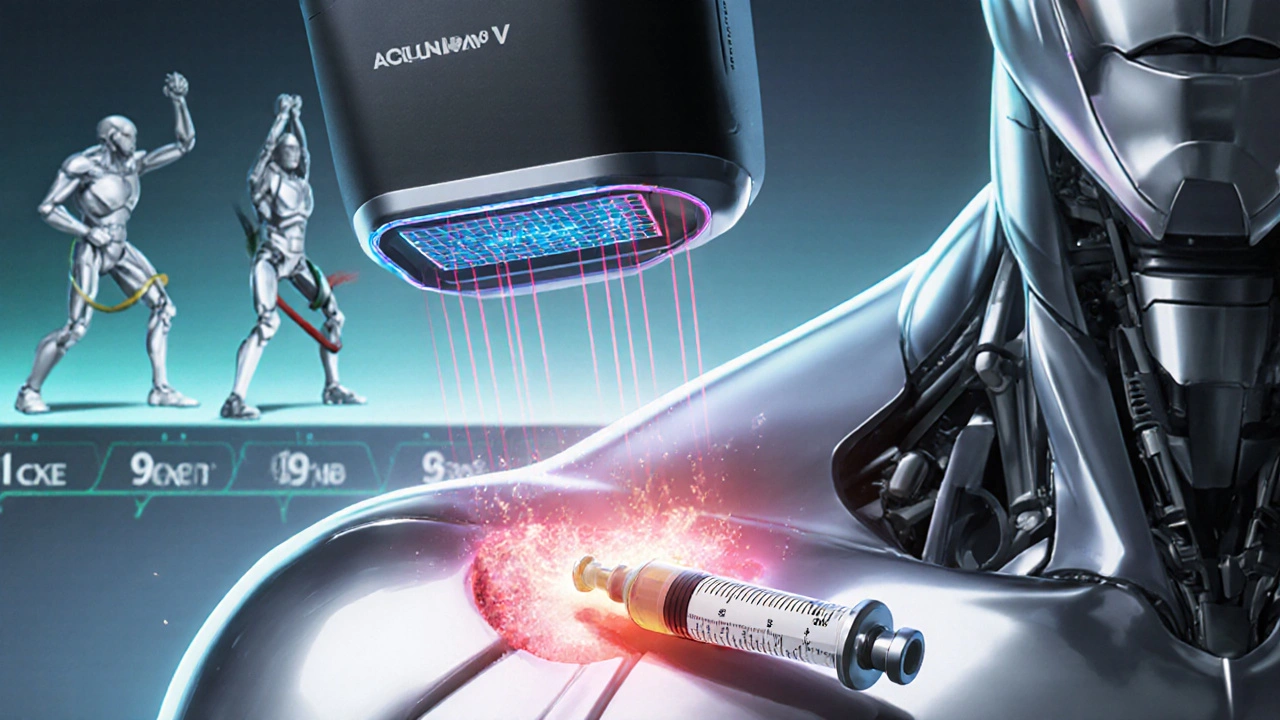
Things are changing fast. In 2024, the FDA approved a new ultrasound-guided injection system called AcuNav V that improves accuracy from 72% to 94%. That means fewer missed shots and less risk of damage.
Platelet-rich plasma (PRP) injections are now recommended as a second-line option after steroids fail. A 2024 multi-center trial showed PRP had a 68% success rate in reducing pain and improving function - better than repeat steroid shots.
And for older adults? Blood flow restriction training (BFR) is gaining traction. It uses a cuff to gently restrict blood flow while doing light exercises. Mayo Clinic research shows it cuts recovery time by 30% for people over 60. It’s not magic - it’s science. You’re tricking your muscles into thinking they’re working hard, even when you’re using light resistance.
Why Most People Fail - And How to Succeed
Here’s the hard truth: 80% of people get better with non-surgical care - but only if they stick to the plan. The biggest reason people don’t? Pain during rehab. It’s uncomfortable. You feel like you’re making it worse. But here’s the key: it’s not about pain-free movement. It’s about pain-controlled movement. Stay below a 5 on the pain scale. If you’re at a 7 or 8, you’re overdoing it.
Another reason? Bad instructions. Many clinics hand out paper sheets with drawings. But 63% of patients who said therapy "worked" mentioned getting video demos they could watch at home. A simple YouTube video or app-based guide makes all the difference.
And cost matters. Physical therapy over 12 weeks costs $1,500-$3,000. Surgery? $15,000-$20,000. Medicare covers most of it for seniors, but you still need to show progress. Insurance won’t pay for 20 sessions if you’re not improving. So consistency isn’t optional - it’s your ticket to getting covered.
When to See a Doctor - And When to Wait
You don’t need to rush to the ER. But if you have any of these, get checked:
- Sharp, sudden pain after a fall or lift
- Inability to lift your arm at all
- Weakness in your hand or arm
- Pain that doesn’t improve after 4-6 weeks of rest and ice
If you’re over 60 and have a full-thickness tear, your chances of healing without surgery are low - only about 40%. Partial tears? 75%. So age and tear type matter.
But for most people under 60 with tendinitis or bursitis - no tear - the answer is clear: give rehab 8-12 weeks. No injections. No surgery. Just movement, consistency, and patience.
What You Can Do Today
Start simple. Right now:
- Apply ice to your shoulder for 15 minutes.
- Do 3 sets of 10 scapular retractions - squeeze your shoulder blades together.
- Set a phone reminder to do pendulum swings tomorrow morning.
You don’t need fancy gear. You don’t need a gym. Just your body and a little discipline. Shoulder pain doesn’t have to be permanent. Most people get back to normal - if they don’t give up too soon.




12 Comments
Phil Thornton
This is the most practical shoulder guide I've read in years. No fluff, just actionable steps. I've been dealing with this for 18 months and your rehab plan is the first thing that made sense.
Barbara McClelland
I love how you emphasized scapular retractions. Most PTs skip that and go straight to bands. My shoulder finally stopped screaming after I started doing those daily. Keep it up!
Alexander Levin
FDA approved AcuNav V? LOL. They're just trying to sell more gear. Next thing you know they'll charge $500 for a $2 ice pack. #BigPharma
Sean Slevin
I've been thinking about this... if the shoulder is the most mobile joint, and also the most unstable-does that mean our evolution prioritized reach over durability? Like, we traded longevity for survival advantage? We were meant to climb, throw, reach... not sit at desks and type for 8 hours. Maybe the real problem isn't the shoulder-it's our environment. We're mismatched with modern life.
Pranab Daulagupu
The 28% compliance gap between app reminders and no reminders is staggering. This isn't just about rehab-it's about behavioral design. If you want people to heal, make the habit frictionless. That’s the real innovation here.
Chetan Chauhan
i think this is all wrong. my shoulder hurt after i ate a burrito. maybe its the salsa? or the beans? probly the cheese. i did pendulum swings but i used a spoon instead of my arm. it worked better. also ice is for wimps. heat all the way. 🤷♂️
Chris Taylor
Just wanted to say thanks. I’ve been ignoring this pain for 6 months thinking it’d go away. Started the pendulum swings yesterday. Not magic, but it doesn’t hurt as bad. Small win.
Melissa Michaels
The emphasis on consistency over intensity is clinically sound. Studies show that low-load, high-frequency movement promotes tendon remodeling more effectively than aggressive loading. This aligns with current orthopedic literature.
Travis Freeman
As someone who grew up in India and now lives in the US, I’ve seen both systems. In India, people just power through pain. Here, they go straight to surgery. This middle path-rehab, patience, smart movement-is the real wisdom. We need more of this.
Matthew Stanford
I’m a physical therapist. This is one of the clearest summaries I’ve seen. I’m sharing this with all my new patients. The ice vs heat point? Crucial. So many people ruin their progress by heating too early.
Nathan Brown
I used to think pain was a sign to stop. Now I know it’s a sign to adjust. There’s a difference between pain that breaks you and pain that teaches you. This article didn’t just explain my shoulder-it changed how I think about discomfort in general. Thanks for the clarity.
Ady Young
I’ve been doing the scapular retractions for a week now. Honestly? My posture has improved so much I’ve stopped getting neck pain too. Who knew fixing your shoulder could fix your whole upper body? This is the kind of info that should be taught in schools. Not just for athletes-for everyone sitting at computers.