
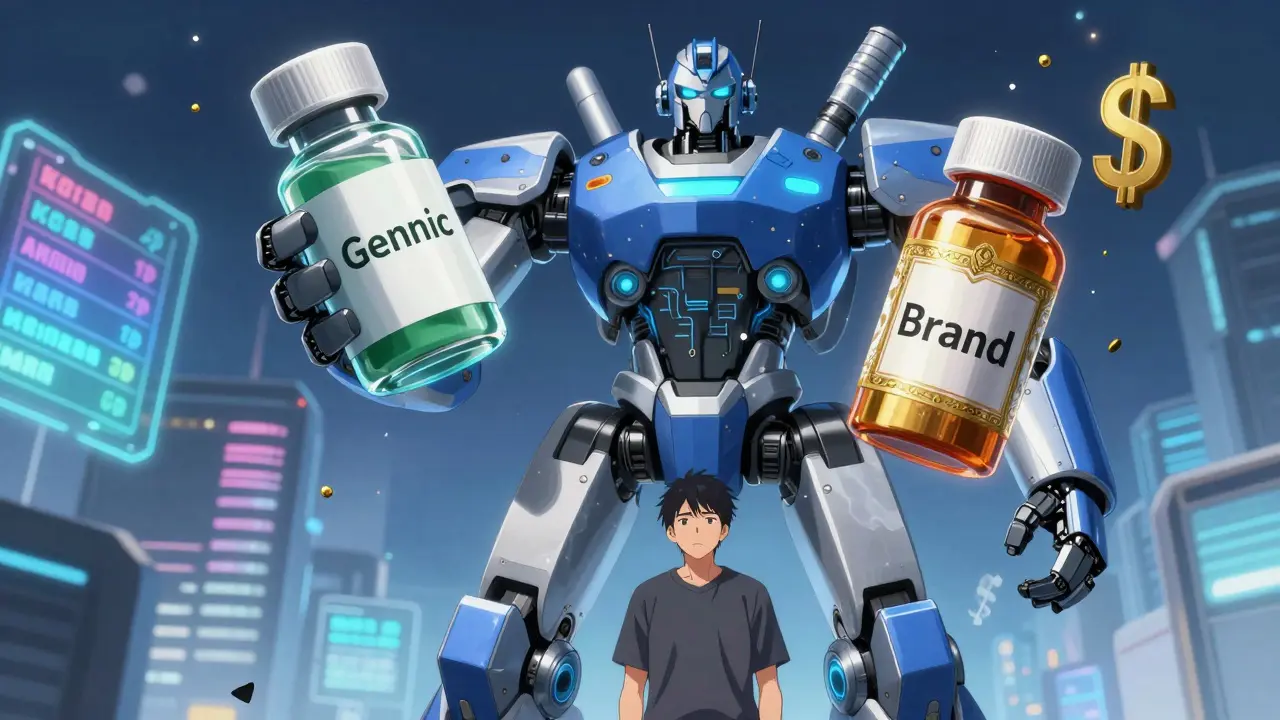
When you pick up a prescription at the pharmacy, the price you pay isn’t just the cost of the drug. It’s shaped by your insurance plan’s structure, and that structure is built around two main types of drugs: generic and brand name. In 2024, the difference in what you pay for these two can be huge - sometimes hundreds of dollars a month. If you’re on multiple prescriptions, especially for chronic conditions like high blood pressure, diabetes, or cholesterol, this gap can make or break your budget.
How Copay Tiers Work in 2024
Most prescription drug plans in the U.S. use a tiered system. Think of it like a pricing ladder. The lower the tier, the cheaper your out-of-pocket cost. In 2024, you’ll typically see four or five tiers:- Tier 1: Preferred Generic - These are the cheapest. Most plans put common generics like lisinopril or metformin here.
- Tier 2: Non-Preferred Generic - Still generic, but slightly more expensive because the plan doesn’t push them as hard.
- Tier 3: Preferred Brand - Brand-name drugs the plan encourages because they’ve negotiated a good deal.
- Tier 4: Non-Preferred Brand - The expensive ones. Your plan doesn’t like these much, so you pay more.
- Tier 5: Specialty - For complex drugs like biologics or cancer treatments. These can cost hundreds or even over a thousand per month.
Medicare Part D plans cover over 53 million people in 2024. Nearly every single one uses this tiered system. The goal? Push you toward cheaper options - usually generics - without denying you access to brand drugs if you really need them.
Average Copays in 2024: The Numbers
Here’s what most people actually paid out of pocket in 2024, based on data from Medicare and major insurers:- Generic Copays: Between $0 and $10 per prescription. For preferred generics, $4.50 was the standard in many Medicare plans. Some plans even had $0 copays.
- Brand Name Copays: Much higher. Preferred brands averaged $47 per prescription. Non-preferred brands? Median $100. Some people paid $150 or more for a 30-day supply.
For example, if you take a generic blood pressure pill, you might pay $5. But if your doctor prescribes the brand version, you could pay $95 - even if it’s the same active ingredient. That’s not a mistake. It’s by design.
Commercial insurance plans (like those from employers) work differently. Instead of fixed copays, many use coinsurance - meaning you pay a percentage of the drug’s total cost. A generic might cost you 10-20%. A brand name? 30-50%. So if the brand drug costs $200, you pay $60 to $100. That’s way more than the $47 median for Medicare.
Medicare Advantage vs. Standalone Drug Plans
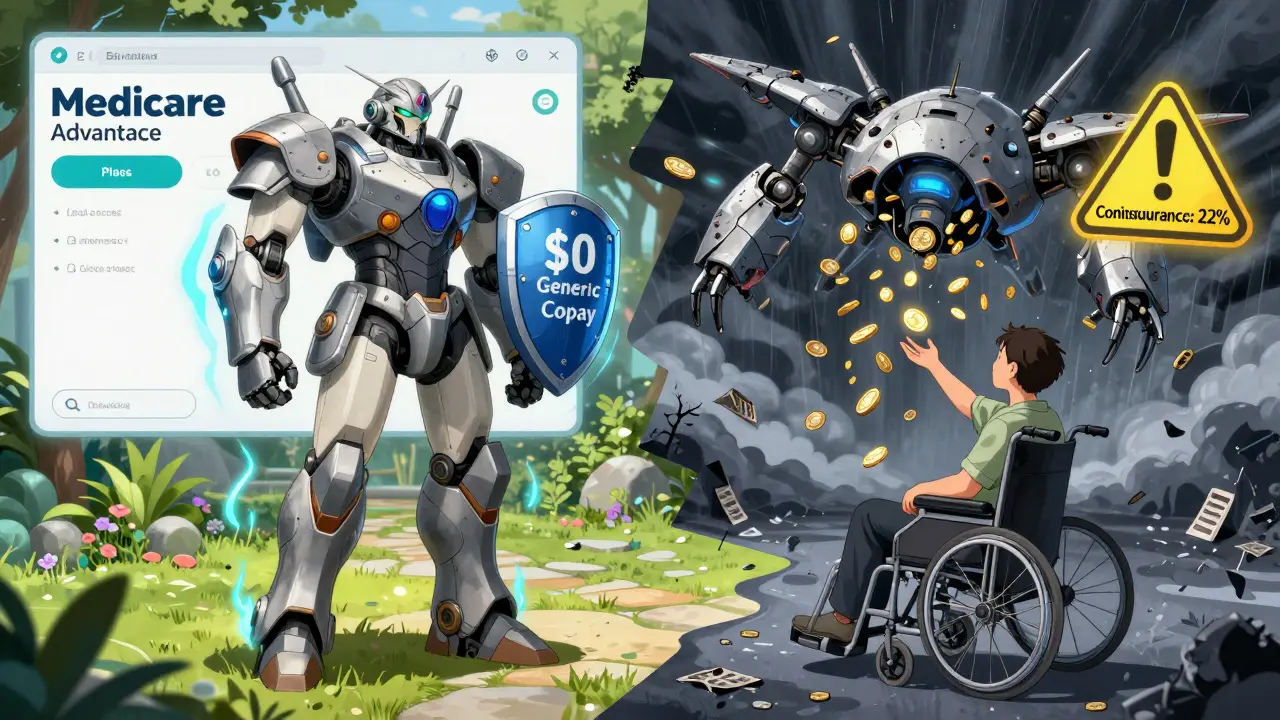
Not all Medicare plans are the same. There are two main types:- Medicare Advantage Prescription Drug (MA-PD) plans bundle your medical and drug coverage. Most of these use fixed copays. So if your plan says brand drugs cost $100, you pay $100 every time - no surprises.
- Standalone Prescription Drug Plans (PDPs) only cover drugs. These often use coinsurance. So if the drug price goes up, your cost goes up too. In 2024, 89% of PDP enrollees paid coinsurance for brand drugs, with a median rate of 22%. That means if the drug jumped from $80 to $100, your payment went from $17.60 to $22 - and you didn’t get a heads-up.
This difference matters. If you’re on a brand drug, MA-PD plans give you predictability. PDPs can leave you with unexpected bills.
The "Member Pay the Difference" Trap
Some commercial plans have a sneaky rule: if you pick a brand name drug when a generic is available - even if your doctor says "dispense as written" - you pay the difference.Let’s say:
- Generic atorvastatin (Lipitor’s generic) costs $12.
- Brand Lipitor costs $95.
- Your copay for the generic is $10.
- Your copay for the brand is $47.
But your plan also says: "Pay the difference." So you don’t just pay $47. You pay $47 + ($95 - $12) = $130. That’s $83 extra - just because you chose the brand.
People on Reddit and Medicare forums are furious about this. One user wrote: "I got charged $42 extra because my doctor wrote 'dispense as written' on the script. The pharmacy said the plan forced them to charge it." That’s not a glitch. It’s policy.
What’s Changing in 2025?
The Inflation Reduction Act didn’t just make temporary fixes - it’s rewriting the rules. Starting January 1, 2025:- The annual out-of-pocket cap for Medicare Part D drops to $2,000. That means no matter how many brand drugs you take, you won’t pay more than that in a year.
- 98% of Medicare Part D plans will have $0 copays for preferred generics - up from 87% in 2024.
- The $35 monthly cap on insulin stays, and it now covers both brand and generic insulin.
These changes are huge. For people on expensive brand drugs, it’s a lifeline. For those on generics, it’s a bonus. But here’s the catch: the cap only applies after you’ve hit $2,000 in spending. So if you’re on three brand-name drugs, you might still pay $100+ per month until you hit that limit.
Why Brand Drugs Cost So Much More
You might wonder: why does a pill with the same active ingredient cost 20 times more?It’s not just marketing. Brand drugs have patent protection - meaning only the original maker can sell it for 10-12 years. After that, generics flood the market. But here’s the twist: even after generics are available, some drug manufacturers pay pharmacies and wholesalers to keep prices high. A 2024 report from MedPAC found that "tying arrangements" - where a pharmacy gets a better deal on brand drugs only if they accept inflated prices on generics - are still common.
One independent pharmacist in Oklahoma told investigators: "We’re forced to pay more for generics to keep getting the brand drugs we need to stay in business. It’s not about profit - it’s about survival. And the cost gets passed to you."

What You Should Do Right Now
If you’re on prescriptions, don’t guess. Do this:- Check your plan’s formulary. Every plan must publish it by October 15 each year. Look up your exact drugs - not just the category.
- Use the Medicare Plan Finder. Type in your medications, zip code, and pharmacy. It shows real costs across plans. Don’t just look at premiums - look at drug copays.
- Ask about alternatives. 72% of Medicare plans offer a preferred generic for at least 80% of common brand drugs. Ask your doctor: "Is there a cheaper version that works just as well?"
- Calculate annual cost. A $5 generic copay sounds great - until you hit a $100 brand drug 12 times a year. That’s $1,200. A plan with a $40 brand copay might cost only $480 total. Don’t focus on monthly copays - look at the whole year.
- Consider Extra Help. If your income is low, you may qualify for Extra Help from Social Security. In 2024, it capped generic copays at $4.50 and brand at $11.20.
Real Stories From Real People
One user on MedicareInteractive.org wrote: "I pay $95 for a non-preferred brand drug. The generic would be $15. My doctor won’t switch me because I had side effects on the generic. I’m stuck. I skip doses to make it last."A 2024 survey by the Medicare Rights Center found that 63% of people on brand drugs had trouble affording them. Only 28% of people on generics said the same.
That’s not just about money. It’s about health. Skipping doses because you can’t afford your meds leads to hospital visits - which cost far more.
Final Thought: It’s Not Fair - But It’s Manageable
The system isn’t designed to be simple. It’s designed to save money for insurers and Medicare - and sometimes, that means you pay more. But you’re not powerless. You have tools. You have rights. And starting in 2025, the rules are finally shifting in your favor.Know your plan. Know your drugs. Ask questions. And don’t assume the cheapest plan is the cheapest overall. Sometimes, the plan with a slightly higher premium saves you hundreds on drugs.
Are generic drugs as effective as brand name drugs?
Yes. By law, generic drugs must contain the same active ingredient, strength, dosage form, and route of administration as the brand version. They must also meet the same FDA standards for safety and effectiveness. The only differences are inactive ingredients (like fillers or dyes) and packaging. For 95% of prescriptions, generics work just as well. The main reason doctors prescribe brand drugs is habit, not medical necessity.
Can I switch from a brand drug to a generic?
You can - but only if your doctor approves it. Some medications, like seizure drugs or thyroid medications, require very precise dosing. Switching can sometimes cause issues. If your doctor says "dispense as written," your pharmacy must follow that. But if they’re open to it, ask. Many people switch without problems and save hundreds per year.
Why does my pharmacy charge more for a generic than the cash price?
Because your insurance plan negotiates prices with pharmacies - and sometimes those negotiated prices are higher than the cash price. This happens often with generics. The cash price at Walmart or Costco might be $4, but your plan’s contracted price is $12. That’s because pharmacies get paid more for brand drugs, and insurers use those profits to offset generic costs. Always compare cash prices - you might pay less without insurance.
What if I can’t afford my brand drug?
Talk to your doctor. Ask if there’s a therapeutic alternative on a lower tier. Many brand drugs have cheaper generics or similar drugs in the same class. You can also apply for patient assistance programs from drug manufacturers - most offer free or low-cost drugs to those who qualify. Nonprofits like NeedyMeds and GoodRx also list savings programs. Don’t skip doses. There are options.
Will the $2,000 out-of-pocket cap in 2025 help me if I take mostly generics?
It will help, but not as much. If you’re only on generics with $0 or $5 copays, you’re unlikely to hit the $2,000 cap. But if you take a mix - even one brand drug - you’re more likely to hit it. The cap is designed to protect people who need expensive drugs. If you’re on mostly generics, you’ll still benefit from the $0 copays and lower overall drug spending in the system.


14 Comments
Sarah B
Generics work fine. I've been on them for years. Brand names are just corporate greed dressed up as science. Stop paying extra for logo pills.
Patrick Jarillon
You think this is about drugs? Nah. This is Big Pharma's way of keeping you docile. They buy off regulators, manipulate formularies, and pay pharmacists to push expensive brands. The $2000 cap? A distraction. They're already planning the next loophole. I've seen the internal memos. You think you're saving money? You're just getting a better seat on the sinking ship.
AMIT JINDAL
bro u know what i did last month? i went to my local pharmacy and asked for the cash price on my atorvastatin... it was $3.50. i paid cash. no insurance. no drama. they even gave me a free lollipop. i mean... why are we even talking about copays? the system is rigged but the solution is so simple. just don't use insurance for generics. wtf is wrong with people?? 😅
Heather Burrows
I don't care what the data says. I've been on Lipitor for 15 years. I know how my body reacts. I'm not some lab rat to be shuffled between pills because some spreadsheet says it's 'equivalent'. Your 'generic' might have different fillers. Different absorption rates. Different side effects. They don't test for that. And now you want me to risk my health because it's cheaper? That's not smart. That's negligence dressed up as policy.
Marcus Jackson
The tier system is a joke. I'm on tier 4 for my meds. Paying $120/month. My neighbor on Medicare pays $10. Why? Because he's old. I'm 42. Employed. No one cares about working people. The system only protects the elderly. That's not healthcare. That's ageism with a pharmacy counter.
Lakisha Sarbah
I switched from brand to generic for my thyroid med and had a panic attack. Not because of the drug. Because my heart started racing. Turns out the generic had a different dye. My doctor said 'it's the same' but my body said otherwise. I went back. Worth every dollar. Not all generics are created equal. Don't let anyone tell you otherwise.
Ariel Edmisten
Check your cash price first. Always. I paid $15 with insurance for my generic. Cash was $7. Just ask. No one tells you this. But pharmacies have to tell you if you ask.
Niel Amstrong Stein
Honestly? I feel like we're all just pawns in a game we didn't sign up for. The system is designed to make us feel powerless. But here's the thing - we're not. We have choices. We can ask. We can switch. We can pay cash. We can fight. It's exhausting. But we're still here. Still breathing. Still managing. And that's kinda powerful, y'know? 🌱
Paula Sa
I'm so glad someone finally broke this down. I've been trying to explain this to my mom for months. She's on three brand drugs and didn't realize the Medicare Advantage plan she chose had a $100 copay. She thought 'low premium' meant 'low cost'. We spent two hours on the Medicare Plan Finder. Switched plans. Saved $1,200 a year. It's not magic. Just patience. And knowing where to look.
Mary Carroll Allen
I just found out my pharmacy was charging me $12 for a generic that costs $4 cash. I called my insurance. They said 'oh that's the negotiated rate'. I said 'but why is it higher than cash?' They hung up. Then I called the pharmacy. They said 'we have to charge that because the insurer pays us more for brand drugs so we make up for it on generics'. I was speechless. This isn't healthcare. This is a pyramid scheme with stethoscopes.
Joey Gianvincenzi
The structural inequities embedded within the pharmaceutical reimbursement paradigm are not merely fiscal anomalies; they represent a systemic erosion of distributive justice in public health policy. The commodification of therapeutic necessity - particularly when juxtaposed against the sociopolitical stratification of access - constitutes a moral failure of unprecedented magnitude. One must interrogate not merely the copay tier, but the epistemological foundations upon which pharmaceutical equivalence is presumed.
Ritu Singh
In India, we have generics that cost less than a cup of chai. But here? You're paying for patents, marketing, and lobbyists. It's not about science. It's about power. And yet - people still trust the system. That's the saddest part. We've been taught to believe that more expensive = better. Even when the numbers scream otherwise. Change starts when we stop believing the lie.
Mark Harris
Just switched my dad to a new plan. Saved $800 a year. You don't need to be a genius. Just do the work. Google 'Medicare Plan Finder'. Type in your meds. Click. Done. It's not sexy. But it's free. And it saves lives.
Tola Adedipe
I work in pharmacy. I see this every day. People skip doses because they can't afford the brand. Then they end up in the ER for a stroke or heart attack. The hospital bills them $40k. Medicare pays $30k. The insurer pays $5k. And the drug company? They made $120 on that brand pill. Who's really losing? Not the company. Not the hospital. It's the person who just wanted to take their medicine. We need to fix this. Not tomorrow. Today.